On 14 July 2026, NHS England, on behalf of a strengthened National Quality Board, published a 10-year Quality Strategy for NHS-funded care in England. Its central move is to make quality the organising principle for everything the NHS does, using one shared, value-based definition rather than a fresh set of targets. This is a strategy about coherence and consistency, not new mandates.
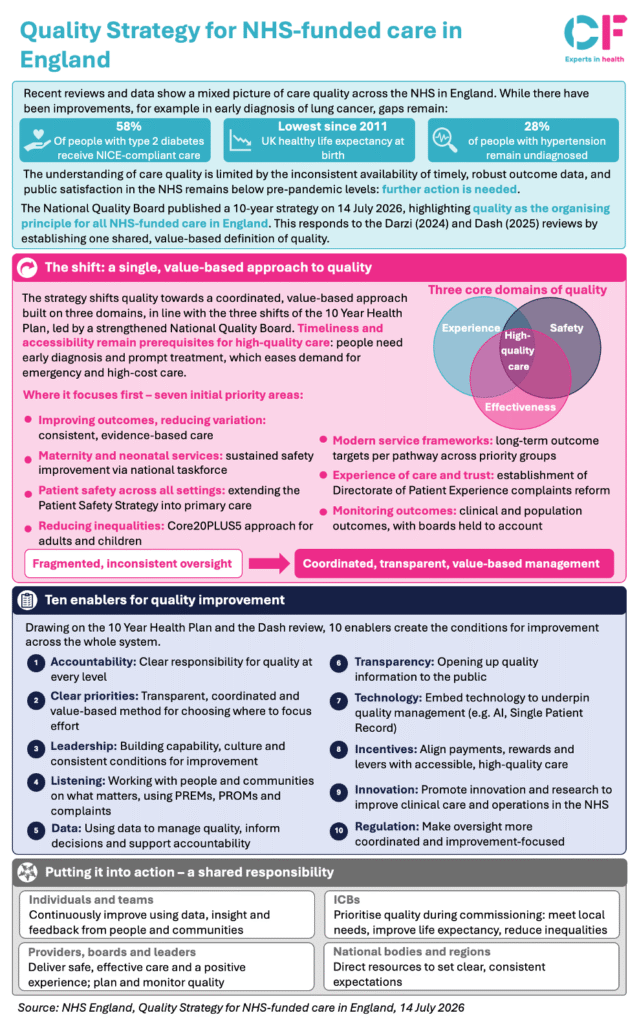
The case for it is a mixed picture of care. Healthy life expectancy at birth is at its lowest since 2011, public satisfaction with the NHS sits below pre-pandemic levels, and around 28 per cent of people with hypertension remain undiagnosed. The strategy responds to Lord Darzi’s 2024 investigation and Dr Penny Dash’s 2025 review of patient safety, both of which pointed to fragmented oversight and unclear accountability.
The key points
- One definition, three domains. Quality is defined consistently across safety, effectiveness and experience, and the strategy treats them as interdependent rather than competing priorities.
- Seven initial priorities. These include improving outcomes and reducing variation through modern service frameworks, sustained improvement in maternity and neonatal services, patient safety across all settings, experience of care and trust, reducing inequalities through Core20PLUS5, and more consistent monitoring of outcomes with boards held to account.
- Ten enablers. Clearer accountability, value-based priority-setting, stronger leadership, listening to communities, better use of data, radical transparency, technology, aligned incentives, innovation, and more co-ordinated regulation.
- A strengthened National Quality Board. The NQB becomes the single body that sets priorities, co-ordinates the flood of national recommendations, and provides one reliable view of quality across the system.
See our snapshot for a full breakdown:
What it means for the NHS
For Integrated care boards , quality moves to the centre of commissioning. They are expected to allocate resources on a value basis, hold providers to account for outcomes, and from 2027/28 will themselves receive a capability rating within their annual assessment. For providers and boards, the deal is greater autonomy within a clearer set of rules, matched by sharper accountability for outcomes, experience and safety, and from 2027 new flexibility to reward clinical teams that consistently deliver. For patients, the promise is more openness: an open-by-default approach to quality data and expanded public league tables.
The honest question is deliverability. The strategy deliberately avoids new targets and arrives without significant new money, so its power rests on whether the enablers actually land: whether the data infrastructure becomes coherent, whether regulation genuinely aligns, and whether the National Quality Board’s prioritisation carries real weight. Get those right and the NHS has a credible route to consistent, value-based quality. Get them wrong and it risks joining a long list of well-intentioned frameworks.
To read the full NHS Quality strategy, click here.