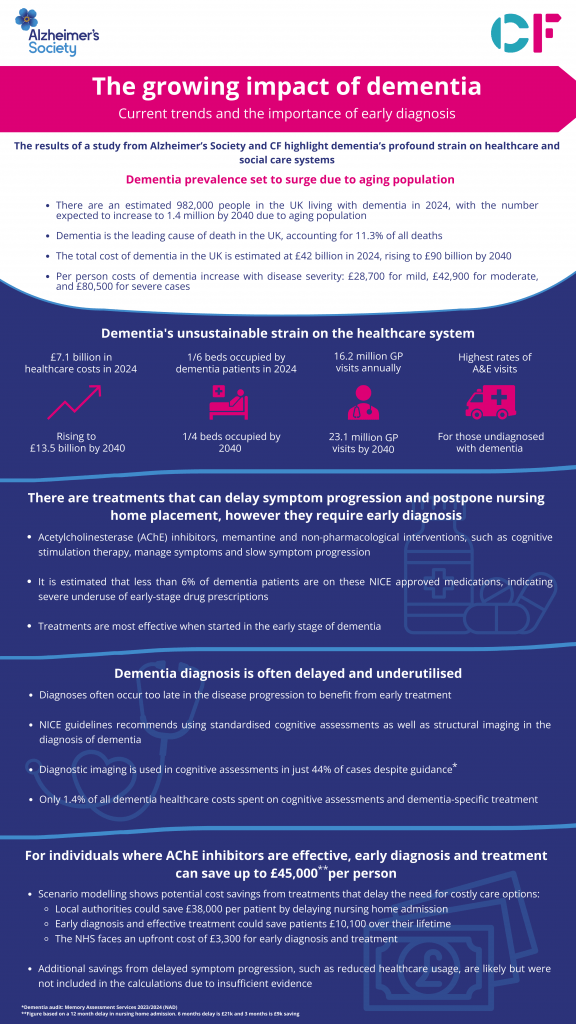
Dementia is now the leading cause of death in the UK, accounting for 11.3% of all fatalities. With an estimated 982,000 people currently living with the condition, this figure is projected to rise to 1.4 million by 2040. The economic impact is equally concerning, with costs expected to surge from £42 billion in 2024 to £90 billion by 2040.
CF was commissioned to investigate the social and economic impact of dementia in the UK. Using our advanced analytical tools, we leveraged a linked, record-level healthcare dataset from a Discover-NOW* database to develop a detailed understanding of the healthcare resource use of people with dementia.
Click to enlarge
Key Findings: The Burden on the Healthcare System
Our study highlights the significant strain that dementia places on the UK’s healthcare infrastructure:
- 36 million annual contacts across community, primary, and mental health services
- Nearly 1 million A&E visits by dementia patients
- On average 1 in 6 hospital beds occupied by dementia patients at any given time
These interactions lead to substantial costs. Healthcare expenditures related to dementia are currently £7.1 billion, which constitutes 14% of the total dementia-related costs. For 2024/25, with NHS spending estimated at £192 billion, dementia care costs make up 3.7% of the total expenditure, even though dementia affects just 1.42% of the population. The breakdown of healthcare costs is as follows:
- 47% allocated to secondary care, including hospital stays
- 21% to mental health services
- 13% to community care
- 10% to prescriptions
- 8% to primary care
Our analysis projects that healthcare utilisation by dementia patients will increase by up to 43% by 2040, pushing total healthcare costs to £13.5 billion.
Key Findings: Gaps in Diagnosis and Treatment
Despite the increasing burden, there remain significant gaps in diagnosis and treatment:
- Only 64.8% of people aged 65 and over with dementia in England receive a formal diagnosis
- Diagnostic imaging and neuro-psychology testing account for just 2% of all outpatient activities
- The current focus on diagnosing dementia in care homes—where the disease is often more advanced—limits opportunities for early intervention
- Less than 6% of dementia patients are on these NICE approved medications, indicating severe underuse of early-stage drug prescriptions
The Case for Investment in Early Interventions
Investing in early and accurate dementia diagnosis is critical for multiple reasons. It enables timely interventions that slow symptom progression, reduce the need for intensive care, and significantly enhance patient quality of life. Additionally, early interventions can help reduce the long-term strain on healthcare resources.
Our study uses scenario modelling to assess potential cost savings from early diagnosis and treatment. The results show that early intervention could delay care home placements by an average of 12 months, generating savings of £8,800 to £44,900 per person by postponing the need for expensive nursing home admissions.
Please contact us today to find out more about this research and our work in data, digital and RWE.
*Discover-NOW database. (Accessed 2024). https://discover-now.co.uk
Report | The growing impact of dementia and the importance of early diagnosis
Earlier diagnosis and treatment could delay the need for more expensive care for some people with Alzheimer’s disease. Modelling suggests lifetime savings of between £8,800 and £44,900 per person where nursing home admission can be delayed.
Contents
- Introduction to the study
- Executive summary
- Supporting literature, methodology, assumptions and limitations
- Potential savings from earlier diagnosis and treatment
- References
1. Introduction to the study
CF partnered with Alzheimer’s Society to produce a report in four modules, to understand the current and future economic and healthcare impact of dementia. This page presents Module 4.
Module 1
Overall annual cost of dementia now and projected to 2040, broken down by cost type (healthcare, social care, unpaid care, quality of life and economic costs), dementia severity, and regions of England and the devolved nations.
Module 2
Healthcare utilisation now and projected to 2040 for people with dementia: A&E attendances, inpatient admissions, outpatient appointments, primary care, community and mental health contacts, and prescriptions.
Module 3
Cost and outcome comparisons with other conditions, for example cancer and cardiovascular disease, and with similar countries.
Module 4: presented here
Potential cost savings from early and accurate diagnosis and effective treatment.
The aim of the study
The projected rise in dementia prevalence poses a significant healthcare, social care and economic challenge, and highlights the urgent need to prioritise dementia as a health and care concern. CF was commissioned to develop a body of evidence illustrating the economic impact of dementia in the UK.
The research estimates the present and future costs of dementia to 2040 across a broad spectrum of cost categories, and examines the healthcare utilisation of people with dementia in detail. It identifies insights into current dementia management and sets out findings and strategies for future management.
- This is one of the largest UK studies of healthcare utilisation by people with dementia, using a study cohort of 26,097 people with dementia across North West London. The data enabled identification of people with mild, moderate and severe dementia using MMSE results recorded for 2,757 patients.
- The study took a data-led, real-world evidence approach, using linked record-level patient data across primary and secondary care, mental health, community services and prescribing to identify real per person healthcare costs.
- The study considered costs beyond health and social care, including quality of life costs (additional heating, legal costs, transport, police call-outs and scams) and loss of economic consumption. Costs were separated by payer, to show what individuals and their families carry.
- The study estimated the healthcare costs of people with undiagnosed dementia compared with people who have a diagnosis, by analysing two years of healthcare costs before diagnosis.
- The data draws on national datasets for population forecasts and real-term price trends to project costs to 2040, and on health and social care statistics to extrapolate activity and cost projections to other regions of England, and to Scotland, Northern Ireland and Wales.
Previous work the study builds on
These studies supported key assumptions on dementia prevalence and use of care services.
| Study | What it covered |
|---|---|
| Prince, M. et al. (2014). Dementia UK: update. Alzheimer’s Society. | Aimed to provide an accurate understanding of dementia prevalence and cost in the UK, to support policy development, influencing, commissioning and service design. Used an expert Delphi consensus approach based on a systematic literature review. |
| Wittenberg, R. et al. (2019a). The costs of dementia in England. | Estimated the societal costs of dementia in England for 2015, covering health, social and unpaid care. Estimates drew on ONS population projections, the Population Ageing and Care Simulation (PACSim) model, the Cognitive Function and Ageing Study (CFAS II) and the MODEM project. |
| Wittenberg, R. et al. (2020). Projections of care for older people with dementia in England: 2015 to 2040. | Built on Wittenberg et al. (2019a) to project cost and prevalence estimates to 2040 in England. People aged under 65 are not included. |
| Wittenberg, R. et al. (2019b). Projections of older people living with dementia and costs of dementia care in the United Kingdom, 2019 – 2040. | Built on both earlier Wittenberg studies to develop prevalence and cost estimates to 2040 for the rest of the UK. |
Sources: Kingston, A. et al. (2018); Comas-Herrera, A. et al. (2017); Matthews, F. E. et al. (2016)
2. Executive summary
Earlier diagnosis and treatment could delay the need for more expensive care for some people with Alzheimer’s disease, creating lifetime savings of between £8,800 and £44,900.
64.8%
Of people aged 65 and over in England with dementia are formally diagnosed, slightly below the 66.7% target
£44,900
Potential lifetime saving per person where nursing home admission is delayed by 12 months
£10,100
Of that saving falls to people with dementia and their families
- NHS England reports that 64.8% of people aged 65 and over in England with dementia are formally diagnosed, slightly below the 66.7% target. In Scotland, Wales and Northern Ireland, estimated diagnosis rates are 64%, 53.9% and 62% respectively.
- Dementia is sometimes diagnosed while people are already in care homes, at a more advanced stage. Diagnosis at that point is still valuable, but there is less opportunity to intervene and change the course of the disease.
- For older adults, prevention and treatment should aim to delay the onset of severe symptoms, compressing the period of ill health into later life. That reduces the time during which people need intensive care, and improves their quality of life.
- For some people with dementia, available treatments can delay the progression of symptoms and the need for nursing home care. As well as supporting quality of life and independence, this offers potential cost savings by delaying the expensive, intensive care that the more severe stages require.
- Early and accurate diagnosis is what makes those benefits possible. Modelling suggests savings of £8,800 to £44,900 per person where nursing home admission can be delayed through effective management and treatment of Alzheimer’s disease.
- Other benefits are likely, including reduced need for unpaid care and healthcare services, but the current evidence does not allow them to be quantified. The modelling also excludes other effective interventions such as memantine and cognitive stimulation therapy, so potential savings could be higher than those modelled.
- The modelling rests on a critical assumption: that treatment does not change survival time. The cost savings do not hold if people live longer and therefore need a longer overall period of care, although other benefits remain.
- More long-term studies and real-world evidence are needed to understand the impact of available treatments fully. That research matters for improving outcomes for people affected by dementia, and for realising the benefits of early diagnosis and intervention.
Sources: NHS Digital (2024); Public Health Scotland; Alzheimer’s Research UK Dementia Statistics Hub (2024); CF analysis
3. Supporting literature, methodology, assumptions and limitations
The aims of early diagnosis and treatment
The main aims are to reduce the impact of the disease on people’s lives, as well as the costs of care.
- In the Chief Medical Officer’s 2023 annual report, Chris Whitty set out how prevention and treatment for older people should focus on compressing the period of illness into later life.
- Several treatments for dementia are at varying stages of development and approval that aim to alter the course of the disease and delay its progression. These are known as disease modifying treatments.
- Treatments already available, including acetylcholinesterase (AChE) inhibitors, can help treat the symptoms of the disease but do not delay progression.
- Studies have shown that early initiation of treatment is associated with long-term benefit, which is why a timely and accurate diagnosis matters: it is what allows treatment to start.
Estimated per person costs of dementia, by severity and setting
2024 UK average, annual cost per person
| Cost type | Mild | Moderate | Severe |
|---|---|---|---|
| All costs | £28,676 | £42,793 | £80,892 |
| Social care | £16,464 | £8,759 | £47,629 |
| Unpaid care | £9,688 | £33,369 | £32,265 |
| Healthcare | £7,734 | £7,437 | £7,976 |
| Economic costs | −£2,500 | −£5,000 | −£7,500 |
| Quality of life costs | £910 | £1,709 | £522 |
- As well as improving quality of life, treatments can reduce the costs associated with dementia.
- Costs increase with disease severity, especially the social care and unpaid care components.
- This module looks at the potential cost savings if the time during which people need the higher levels of care associated with more severe symptoms is reduced.
- The study is restricted to AChE inhibitors, which can be offered as treatment for people with Alzheimer’s disease. Memantine and cognitive stimulation therapy also offer benefits but are not considered in this analysis.
Sources: Whitty, C. (2023); Rountree, S. E. et al. (2009); Loy, C. T. et al. (2019); CF analysis
What the research shows about AChE treatments
Research has shown that acetylcholinesterase inhibitors, including galantamine, rivastigmine and donepezil, can delay nursing home placement if taken early enough.
- Several studies show that people with dementia who receive more persistent exposure to inhibitor drugs over the course of their illness decline significantly more slowly on key measures of cognition, global functioning and basic activities of daily living, and that these effects are cumulative over time.
- Studies have also shown that inhibitors can delay dementia-related nursing home placement.
- Some studies have found associations between AChE inhibitor use and decreased risk of myocardial infarction, stroke and death in patients with dementia.
- Few randomised controlled trials examine the effectiveness of AChE inhibitors in Alzheimer’s disease beyond one year of treatment, or follow up beyond that point.
- Studies of long-term cognitive decline are difficult because of high attrition and loss to follow-up.
- The ethical difficulty of prolonged exposure to placebo generally limits longer-duration randomised trials.
- Where data does exist, the findings are mixed, because the treatment is not effective for everyone.
- Studies have shown that early initiation of treatment is associated with long-term benefit, while withdrawal and re-initiation of treatment is detrimental.
- This analysis focuses on AChE inhibitors and does not consider memantine or cognitive stimulation therapy.
- It does not consider disease modifying treatments, as none are currently approved for use in the NHS.
- Some studies indicate a potential benefit from AChE inhibitors; others do not find significant effects.
- More robust, longer-term studies are needed to determine the true impact of these medications.
Sources: Rountree, S. E. et al. (2009); Loy, C. T. et al. (2019)
The modelled scenario
This analysis presents scenario modelling to show the potential cost savings if someone receives treatment that delays their need for more costly types of care.
| Point in the disease | Current | Modelled scenario |
|---|---|---|
| Onset of mild dementia | Age 81 | Age 81 |
| Diagnosis | Age 83 | Age 82 (earlier diagnosis) |
| Care home admission | Age 86 | Age 87 (delayed admission) |
Earlier diagnosis means people can intervene earlier, through lifestyle changes as well as available treatments including AChE inhibitors.
Delayed admission: there is evidence that treatment can delay nursing home admission for people with Alzheimer’s disease. This is modelled as a reduction in nursing care costs over a person’s lifetime.
A note on methodology: this analysis presents the cost savings in a possible scenario where AChE inhibitors are effective in delaying care need progression. Evidence on the effectiveness of AChE inhibitors informed this scenario, but the analysis does not include an exhaustive review of publications on these treatments. The median ages are evidence-based but taken from a variety of sources.
Sources: median age of onset based on incidence rates from Matthews, F. E. et al. (2016) applied to ONS (2020) population projections; median age at diagnosis from the DiscoverNOW cohort; median age at care home admission from Stilwell, P. et al. (2012)
Cost and time parameters used in the modelled scenario
The costs and time periods are based on literature review and analyses performed in previous work.
| Group | Parameter | Value | Justification |
|---|---|---|---|
| Costs | Cost of diagnosis | £897 |
|
| Cost of treatment with AChE inhibitors | £112 |
|
|
| Cost of healthcare activity after diagnosis | £1,000 |
|
|
| Cost of domiciliary care | £15,561 |
|
|
| Cost of nursing home care | £63,689 |
|
|
| Time periods | Increased time spent as a diagnosed patient | 12 months |
|
| Delay in admission to nursing care | 12 months (3 – 6 months also modelled) |
|
|
| Overall survival time | No change |
|
Sources: Giebel, C. M. et al. (2019); ONS (2023); PSSRU (2023); Care Information Scotland (2024); CF analysis
Evidence on the length of delay in symptom progression
Evidence is limited, because most randomised controlled trials last less than 18 months.
| Study | Study type and cohort size | Delay in symptom progression | Findings |
|---|---|---|---|
| Arvanitakis, Z. et al. (2009) | Literature review based on 22 observational studies and 5 randomised clinical trials | 6 months |
|
| Knight, R. et al. (2018) | Systematic review and meta-analysis | 3 months |
|
| Lopez, O. et al. (2002) | 270 patients (50% with probable Alzheimer’s disease, 50% control) | 1 year |
|
| Doody, R. S. et al. (2001) | 205 AChE inhibitor-treated and 218 untreated Alzheimer’s disease patients | Not specified |
|
| Birks, J. S. et al. (2018) | Meta-analysis of 28 studies | Not applicable |
|
A note on methodology: the first four studies were used to determine the parameters for the scenario modelling. Birks, J. S. et al. (2018) is included as an example of a study showing limited impact.
Evidence on delay to nursing home admission
The evidence here is stronger, and studies estimate the delay could be as long as 21 months.
| Study | Study type and cohort size | Delay in admission | Findings |
|---|---|---|---|
| Wattmo, C. et al. (2016) | 881 outpatients with an Alzheimer’s disease diagnosis | 3 – 8 months |
|
| Geldmacher, D. S. et al. (2003) | 671 Alzheimer’s disease patients | 18 – 21 months |
|
| Salib, E. et al. (2011) | 339 probable Alzheimer’s disease patients | 12 months |
|
| Lopez, O. et al. (2009) | 943 probable Alzheimer’s disease patients | Not specified |
|
| Feldman, H. H. et al. (2009) | 584 Alzheimer’s disease patients | Not specified |
|
| Halminen, O. et al. (2021) | 7,454 Alzheimer’s disease patients | Not specified |
|
| Courtney, C. et al. (2004) | 565 Alzheimer’s disease patients | Not applicable |
|
A note on methodology: the first six studies were used to determine the parameters for the scenario modelling. Courtney, C. et al. (2004) is included as an example of a study showing limited impact.
Study limitations
| # | Limitation |
|---|---|
| 1 | There is no evidence that AChE inhibitors can halt or reverse the progression of dementia. There is evidence that they can reduce the severity of symptoms, and it is assumed that this reduction leads to a reduction in personal care and healthcare costs. Other treatments, including memantine and cognitive stimulation therapy, have not been modelled. |
| 2 | AChE inhibitors have only been shown to have an impact in Alzheimer’s disease and Lewy body dementia. This study models Alzheimer’s disease only and cannot be extrapolated to other forms of dementia. |
| 3 | It is assumed that earlier treatment leads to a 12-month delay in nursing care costs. This does not affect any other cost estimate, and healthcare savings have not been modelled. |
| 4 | It is assumed that the hypothesised person with Alzheimer’s disease is able to take these drugs and benefits from doing so. In reality, around half of people with Alzheimer’s disease are estimated to benefit from AChE inhibitor treatment, and treatment must start early enough in the course of the disease. |
| 5 | There are limited studies analysing the impact of earlier diagnosis, and many are more than 15 years old. |
| 6 | Early diagnosis carries other important benefits, including giving people more opportunity to plan their future care and helping their families understand how to support them. These are not easily quantified financially, so are not included in this study. |
| 7 | There is regional variation in the costs of dementia and in how they are distributed across payers. Local figures can be substituted into the calculation to estimate potential savings in different geographical areas. |
4. Potential savings from earlier diagnosis and treatment
Effect on lifetime costs for a person with Alzheimer’s disease
The cost saving for a person diagnosed early enough to take treatments that delay symptom progression is estimated at up to £44,887.
| Cost element | Impact |
|---|---|
| Cost of diagnosis | £897 |
| Prescription costs of AChE inhibitors | £1,344 |
| Difference in healthcare costs after diagnosis | £1,000 |
| Additional domiciliary care costs | £15,561 |
| Reduction in nursing home costs | −£63,689 |
| Total cost impact | −£44,887 |
- There is an increase in costs associated with earlier diagnosis and treatment, including the costs of diagnosis and treatment and an incremental increase in healthcare costs.
- Additional domiciliary care costs are assumed for the period of time no longer spent in a nursing home.
- These costs are offset by the saving from the assumed delay in admission to nursing home care.
- The modelling assumes no increase in survival. The effect of that assumption is discussed under sensitivity analysis below.
- Other savings are likely from delayed symptom progression, for instance lower use of healthcare services, but the lack of evidence makes them difficult to quantify.
Sources: CF analysis; PSSRU (2023)
How the savings are distributed by payer
Cost savings are expected to be shared between people with dementia and the state, with people with dementia and their families saving up to £10,000.
| Cost element | Local authority | Self-pay | NHS | Total impact |
|---|---|---|---|---|
| Net impact | −£38,000 | −£10,100 | +£3,300 | −£44,900 |
| Nursing care | −£38,000 | −£25,700 | −£63,700 | |
| Domiciliary care | £15,600 | £15,600 | ||
| Healthcare costs | +£1,000 | £1,000 | ||
| Diagnosis cost | +£900 | £900 | ||
| AChE inhibitors | +£1,300 | £200 |
- Local authorities could save an estimated £38,000 per year for every person for whom they can successfully delay nursing home admission.
- People with dementia can expect to save £10,100 in their lifetime if they are diagnosed early enough to take treatment at a point where it can have the maximum impact.
- The NHS is expected to pay a small cost of £3,300 for early diagnosis and additional treatment. This may be offset by healthcare savings in later years, which are not included in this analysis given the lack of evidence in this area.
- Savings have been modelled for a single representative person. If symptom transitions can be delayed for large numbers of people, there is potential for a significant aggregate saving for local authorities and for people with dementia.
A note on methodology: distribution of costs is based on the average distribution across the UK.
Source: CF analysis
Sensitivity analysis
Delay in nursing care admission
Given the variability in the delay reported in the literature, the analysis was repeated with different assumed lengths of delay. If the delay is three or six months instead of 12, the total potential saving falls to £8,791 and £20,823 respectively.
| Length of delay in nursing home admission | Reduction in cost of nursing care | Overall potential saving |
|---|---|---|
| 12 months | £63,689 | £44,687 |
| 6 months | £31,845 | £20,823 |
| 3 months | £15,922 | £8,791 |
Survival time
- The scenarios presented assume no change to the person’s overall survival time.
- Changes in survival time are difficult to model, and evidence on the impact of AChE inhibitors on survival is mixed. It is unclear how additional time would be distributed across the stages of disease severity and care need, and natural mortality in older people is difficult to predict.
- From Module 1, the annual per person costs of dementia are £28,700 for the mild cohort, £42,900 for moderate and £80,500 for severe. The estimated £44,687 saving would be eroded by an extension in life expectancy of two years in the mild stage, one year in the moderate stage, or six months in the severe stage.
Further research is required
Further research using real-world evidence is needed to understand the economic impact of diagnosis and treatment.
- Several studies have investigated the impact of treatment on Alzheimer’s disease progression, but there is no consensus on the length of delay in disease and symptom progression.
- Progression through the stages of dementia, from mild cognitive impairment to severe dementia, is poorly documented.
- Social care is the largest component of cost, but savings there typically sit outside the scope of the existing literature.
- Longer follow-up studies and more real-world evidence are needed to track the healthcare and cost impact of treatments more accurately, so that the health and care system is ready for new disease modifying therapies.
- More evidence is also needed on behavioural management and non-pharmacological treatments such as cognitive stimulation therapy.
- There is some evidence that Alzheimer’s disease treatment can improve quality of life for people with dementia, and drive a significant cost benefit for both local authorities and people with dementia if taken sufficiently early.
- Healthcare costs are likely to increase marginally per person, but the overall savings and benefits to people and society are potentially significant.
Source: CF analysis
5. References
- Arvanitakis, Z., Shah, R. C., & Bennett, D. A. (2019). Diagnosis and management of dementia. JAMA, 322(16), 1589 – 1599.
- Birks, J. S., & Harvey, R. J. (2018). Cholinesterase inhibitors for Alzheimer’s disease. Cochrane Database of Systematic Reviews, 2018(6). https://doi.org/10.1002/14651858.CD001190.pub3
- Care Information Scotland. (2024). Standard rates. careinfoscotland.scot
- Comas-Herrera, A., Knapp, M., Wittenberg, R., Banerjee, S., Bowling, A., Grundy, E., et al. & MODEM Project group. (2017). MODEM: a comprehensive approach to modelling outcome and costs impacts of interventions for dementia. Protocol paper. BMC Health Services Research, 17, 1 – 8.
- Courtney, C., Farrell, D., Gray, R., Hills, R., Lynch, L., Sellwood, E., et al. & AD2000 Collaborative Group. (2004). Long-term donepezil treatment in 565 patients with Alzheimer’s disease (AD2000): randomised double-blind trial. Lancet, 363(9427), 2105 – 2115. https://doi.org/10.1016/S0140-6736(04)16499-4
- DiscoverNOW database. (Accessed 2024). discover-now.co.uk
- Doody, R. S., Dunn, J. K., Clark, C. M., Farlow, M., Foster, N. L., Liao, T., et al. & Massman, P. (2001). Chronic donepezil treatment is associated with slowed cognitive decline in Alzheimer’s disease. Dementia and Geriatric Cognitive Disorders, 12(4), 295 – 300.
- Feldman, H. H., Pirttila, T., Dartigues, J. F., Everitt, B., Van Baelen, B., Schwalen, S., & Kavanagh, S. (2009). Treatment with galantamine and time to nursing home placement in Alzheimer’s disease patients with and without cerebrovascular disease. International Journal of Geriatric Psychiatry, 24(5), 479 – 488.
- Geldmacher, D. S., Provenzano, G., McRae, T., Mastey, V., & Ieni, J. R. (2003). Donepezil is associated with delayed nursing home placement in patients with Alzheimer’s disease. Journal of the American Geriatrics Society, 51(7), 937 – 944.
- Halminen, O., Vesikansa, A., Mehtälä, J., Hörhammer, I., Mikkola, T., Virta, L. J., et al. & Linna, M. (2021). Early start of anti-dementia medication delays transition to 24-hour care in Alzheimer’s disease patients: a Finnish nationwide cohort study. Journal of Alzheimer’s Disease, 81(3), 1103 – 1115.
- Howard, R., McShane, R., Lindesay, J., Ritchie, C., Baldwin, A., Barber, R., et al. & Phillips, P. P. (2015). Nursing home placement in the Donepezil and Memantine in Moderate to Severe Alzheimer’s Disease (DOMINO-AD) trial: secondary and post-hoc analyses. The Lancet Neurology, 14(12), 1171 – 1181.
- Kingston, A., Robinson, L., Booth, H., Knapp, M., & Jagger, C., for the MODEM project. (2018). Projections of multi-morbidity in the older population in England to 2035: estimates from the Population Ageing and Care Simulation (PACSim) model. Age and Ageing, 47(3), 374 – 380. https://doi.org/10.1093/ageing/afx201
- Knight, R., Khondoker, M., Magill, N., Stewart, R., & Landau, S. (2018). A systematic review and meta-analysis of the effectiveness of acetylcholinesterase inhibitors and memantine in treating the cognitive symptoms of dementia. Dementia and Geriatric Cognitive Disorders, 45(3 – 4), 131 – 151.
- Lopez, O. L., Becker, J. T., Wahed, A. S., Saxton, J., Sweet, R. A., Wolk, D. A., et al. & DeKosky, S. T. (2009). Long-term effects of the concomitant use of memantine with cholinesterase inhibition in Alzheimer disease. Journal of Neurology, Neurosurgery & Psychiatry, 80(6), 600 – 607.
- Loy, C. T., & Schneider, L. S. (2018). Safety and efficacy of donepezil, galantamine, and rivastigmine for Alzheimer’s disease: a systematic review and meta-analysis. Alzheimer’s Research & Therapy, 10, 57. https://doi.org/10.1186/s13195-018-0457-9
- Matthews, F. E., Stephan, B. C., Robinson, L., Jagger, C., Barnes, L. E., Arthur, A., & Brayne, C. (2016). A two decade dementia incidence comparison from the Cognitive Function and Ageing Studies I and II. Nature Communications, 7(1), 11398.
- Office for National Statistics. National population projections: 2020-based interim.
- Office for National Statistics. (2023, 6 July). Care homes and estimating the self-funding population, England: 2022 to 2023.
- NHS Digital. (2024, May). Primary care dementia data, May 2024. digital.nhs.uk
- Prince, M., Knapp, M., Guerchet, M., McCrone, P., Prina, M., Comas-Herrera, M., Wittenberg, A., Adelaja, R., Hu, B., King, B., Rehill, D., & Salimkumar, D. (2014). Dementia UK: update. Alzheimer’s Society.
- PSSRU. (2023). Unit costs of health and social care.
- Rountree, S. D., Chan, W., Pavlik, V. N., Darby, E. J., Siddiqui, S., & Doody, R. S. (2009). Persistent treatment with cholinesterase inhibitors and/or memantine slows clinical progression of Alzheimer disease. Alzheimer’s Research & Therapy, 1, 1 – 7.
- Salib, E., & Thompson, J. (2011). Use of anti-dementia drugs and delayed care home placement: an observational study. The Psychiatrist, 35(10), 384 – 388.
- Stilwell, P., & Kerslake, A. (2012). What makes older people choose residential care and are there alternatives? Institute of Public Care, Oxford Brookes University. ipc.brookes.ac.uk
- Wattmo, C., Londos, E., & Minthon, L. (2016). Short-term response to cholinesterase inhibitors in Alzheimer’s disease delays time to nursing home placement. Neurobiology of Aging, 1(39), S2.
- Whitty, C. (2023). Chief medical officer’s annual report 2023: health in an ageing society. Executive summary and recommendations. UK Government. gov.uk