As part of the Department for Education’s Every Child Achieving and Thriving white paper, the SEND Reform: Putting Children and Young People First consultation document sets out the government’s vision to transform the Special Educational Needs and Disabilities (SEND) system.
The reforms place emphasis on embedding earlier, more flexible and more comprehensive support in mainstream school settings. They aim to ensure inclusive education for all children, with families actively involved in decision-making — and promote shared responsibility for outcomes across local partners through new partnership models.
Five revised principles underpin the proposed changes:
Structures of support
A strong universal offer of high-quality teaching and support for all children — from early years through to age 25 — is central to integrating the SEND system within mainstream education and providing earlier intervention.
For CYP who need additional help to access education, three levels of Targeted and Specialist support will be available:
- Targeted: CYP receive Targeted support from their setting, outlined in a digital Individual Support Plan (ISP) developed with parents.
- Targeted Plus: CYP receive Targeted Plus support from their setting, with input from education and health professionals. School-aged children are also supported through their school group.
- Specialist: CYP receive Specialist support through an Education, Health and Care Plan (EHCP) in a mainstream or special setting, where provision is set out in one of the new nationally defined Specialist Provision Packages.
Key enablers
- Experts at Hand: Health professionals will have more opportunities to work directly with school staff and children. £1.8bn will be invested over three years to improve access to professionals such as speech and language therapists (SLT).
- Individual Support Plans (ISPs): Nurseries, schools and colleges will have a statutory duty to record and monitor SEND and provision in an ISP. ISPs will capture barriers to learning, day-to-day provision, reasonable adjustments and intended outcomes.
- Specialist Provision Packages: Children with the most complex needs will receive comprehensive, evidence-based packages of support. These will form the basis for future EHCPs, setting out the specific interventions, resources and standards required.
Our snapshot provides an overview of the revised SEND reform principles, updated structures of support for children and young people, and the plan for funding and investments that will underpin these changes.
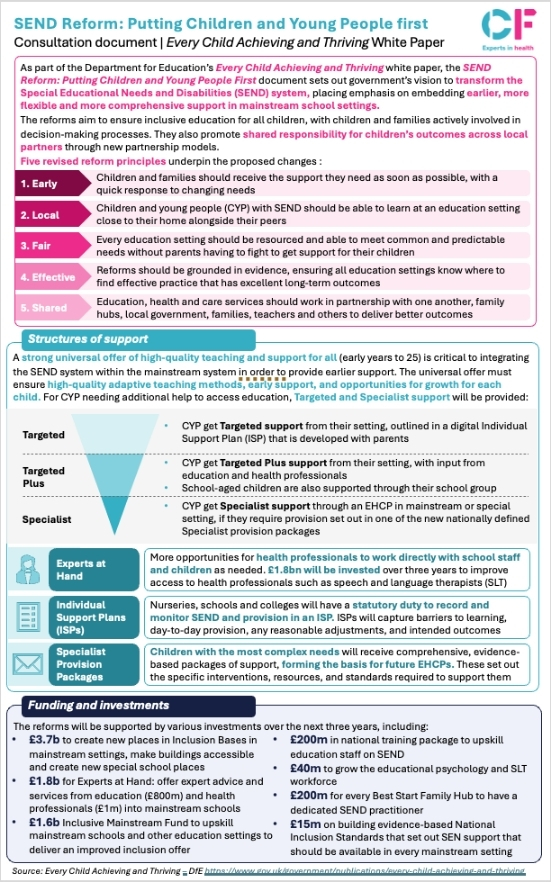
Click to expand
Funding and investments
The reforms will be supported by significant investment over the next three years:
— £1.8bn for Experts at Hand — offering expert advice from education (£800m) and health professionals (£1bn) into mainstream schools.
— £1.6bn Inclusive Mainstream Fund to upskill mainstream schools and other education settings to deliver an improved inclusion offer.
— £200m national training package to upskill education staff on SEND.
— £40m to grow the educational psychology and SLT workforce.
— £200m to ensure every Best Start Family Hub has a dedicated SEND practitioner.
— £15m to build evidence-based National Inclusion Standards, setting out the SEN support that should be available in every mainstream setting.
With over £8bn committed and a clear framework of principles, structures and investment, the SEND reform plan represents one of the most significant overhauls of the system in a generation. Whether it delivers on its promise will depend on how effectively the new support structures are implemented at a local level — and whether schools, health services and families can work together in the way the reforms envision. For those with children and young people at the heart of the system, the direction of travel is encouraging, but the details of delivery will matter most.
Read the full SEND Reform Plan here.