Value in Health

Demonstrating the economic power of health investment

Understanding the true value of healthcare spending goes beyond delivery, it’s about recognising how investment in health systems drives both population health outcomes and economic growth. At CF, we generate robust evidence that demonstrates the measurable returns of strategic health and care investment.

Challenges and opportunities

Despite absorbing an increasing share of public service spending, NHS performance is stagnating or in decline, while public expectations and health needs continue to grow. The 2024 Darzi Report labelled the NHS as “in serious trouble”, a conclusion that underscores the urgent need to re-examine how the system delivers care, how it uses its resources, and how it can be set on a path toward sustainability.

In other words, the NHS needs to consider how it can increase healthcare value to deliver better outcomes and greater output from the available funding.

Delivering more from existing resource
Boosting productivity
Population health management
Investing in prevention

How CF works in this area

Our approach combines sophisticated economic modelling with real-world insight, bridging complex health economics and actionable policy. Through our partnership with the NHS Confederation, we developed the Value in Health series, research that continues to shape funding strategies and inform how decision-makers understand the relationship between NHS spending and economic returns.

Underpinning this work is unparalleled access to data covering 57 million people, integrating hospital activity, clinical, and workforce data. As we expand globally, we are applying this methodology in partnership with health systems worldwide, enabling comparative insights and accelerating improvements in healthcare delivery.

Our research in the news

CF’s latest report with NHS Confederation featured in the Health Service Journal (HSJ)

ICSs spending more out-of-hospital ‘have 15pc less emergency admissions’ – Investing more in community care could save integrated care systems millions of pounds and significantly reduce acute demand, according to a report.”


The New Statesman features CF’s latest report with NHS Confederation

NHS investment ‘would pay for itself fourteen times over’ Researchers have found that an extra £1bn of healthcare funding could lead to a £14bn gain for the economy.”

FT picks up CF’s latest research with NHS Confederation

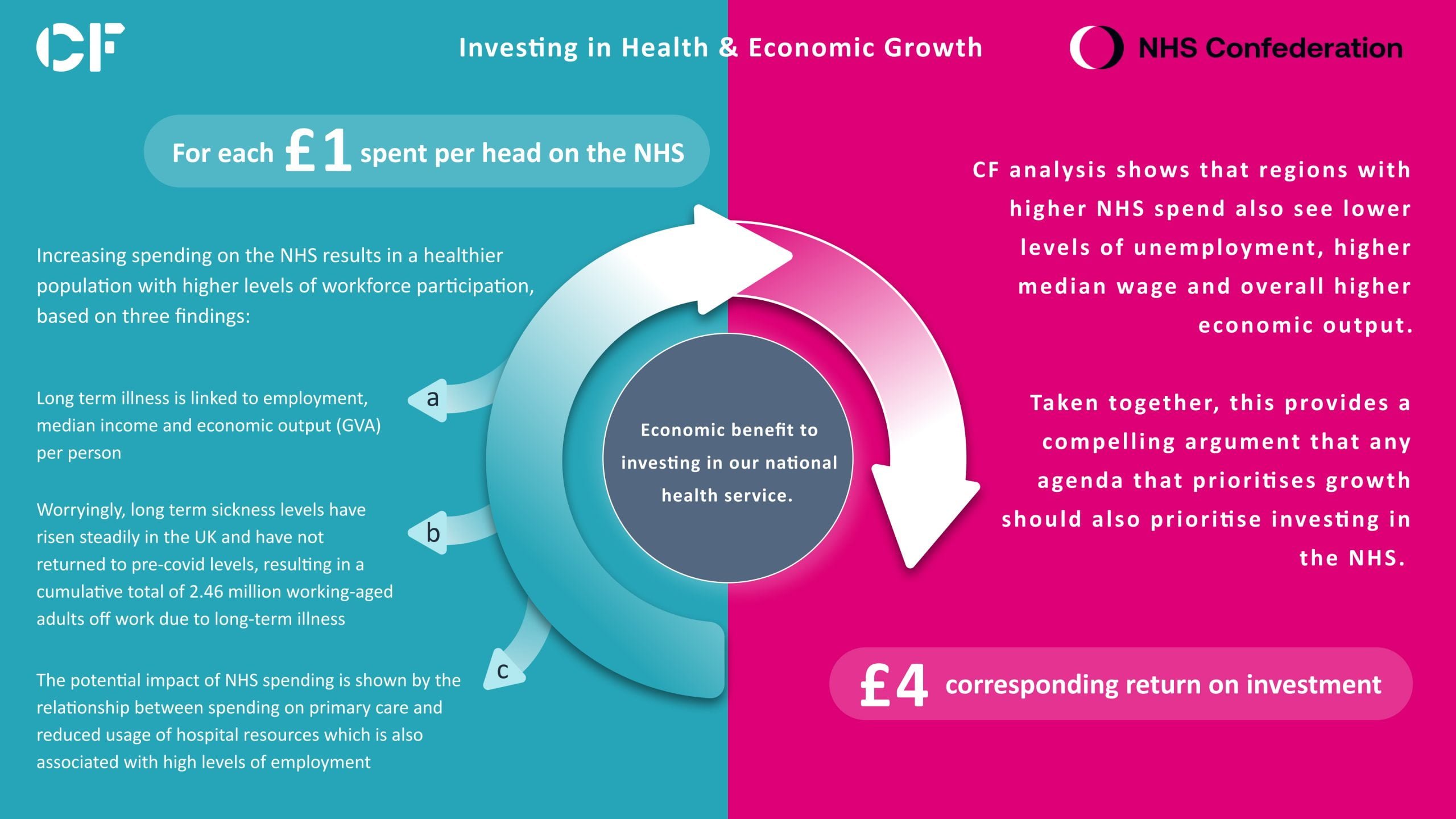
“Increasing spending on the NHS results in a healthier population with higher levels of workforce participation”.

Our expert team

Our expert value in health team combines advanced health economics expertise with deep understanding of healthcare delivery systems. This multidisciplinary knowledge enables us to tackle the complex relationship between NHS investment, health outcomes, and economic returns, ensuring our research provides actionable insights for policymakers and healthcare leaders.


Catherine Skilton

Managing Partner, Health Systems

Ben Richardson

Managing Partner, Life Sciences

Jo Andrews

Partner & Chief Medical Officer, London and Europe

Yemi Oviosu

Senior Manager

FAQ’s

Value in health means getting better health outcomes and greater output from the money a health system already spends, rather than treating spending and outcomes as separate questions. It covers four levers: delivering more from existing resource, boosting productivity, managing population health, and investing in prevention. CF applies economic modelling and patient-level data to quantify each lever, so that funding decisions rest on measured returns rather than assumption.

Primary and community care. CF’s follow-up analysis for the NHS Confederation examined return by care setting and found that places that increased spend on primary and community care between 2015 and 2019 saw markedly higher GVA growth than those that spent least. In areas spending below their level of need, the return reached around £14 for every £1 invested (Creating better health value, 2023). That finding is the economic case for the “left shift” toward care closer to home.

The dominant factor is that clinical workforce growth has outpaced growth in activity and demand. From 2018/19, the annual growth rate in doctors accelerated to 2.3 times, and nurses to 3.7 times, the rate of the preceding five years, without a matching rise in activity or outcomes. The decline began a year before the pandemic, so Covid deepened it rather than caused it. CF recommends four moves: an economic review of safer staffing models, localised workforce planning matched to actual demand, activity-based payment so money follows the patient, and the use of data and AI to cut administrative burden.

Analysis of record-level data across the whole population shows that 22% of people account for 48% of acute costs. People with a single long-term condition make up 6.8% of the population and 7.9% of acute costs; those with multiple conditions are 15% of the population but drive 39.7% of acute costs. Dementia affects just over 1% of the population and accounts for 10% of acute spend. Closing the gap between NICE guidance and delivered care is worth an estimated £3.4bn to £5bn from reducing variation alone, and £6.1bn to £9.2bn from fuller implementation of clinical guidelines.

CF combines economic modelling with linked, patient-level data covering 57 million people, integrating hospital activity, clinical and workforce records. Returns are modelled at the smallest available unit of geography, weighting spend against population need, and validated against figures published by NHS England and submissions to Parliament. Where the evidence is contested, CF publishes the range and the method rather than a single number: the productivity findings, for example, are tested as weighted activity per nurse, per doctor and per pound spent.

Contact us today