An explosion in ADHD interest
Over the last 20 years, there has been a consistent and extraordinary rise in the interest, recognition and treatment of Attention Deficit Hyperactivity Disorder (ADHD) worldwide – in a way that is without precedent for any comparable condition [1].
Health systems have struggled to keep pace with surging demand. Private sector providers have moved quickly to fill the gap. And it has meant significant growth for pharmaceutical companies.
An analysis of Google search data, a reliable real-time proxy for population-level awareness, shows a dramatic increase in interest across multiple countries, reflecting the growing number of individuals and families questioning whether they or their relatives have ADHD and, if so, how best to manage it [2]. The scale and synchronicity of that signal is not random: it reflects a genuine structural shift in how ADHD is understood, discussed and demanded.
Google search interest in ADHD by country, 2004–2026
Relative search interest (0–100, monthly).
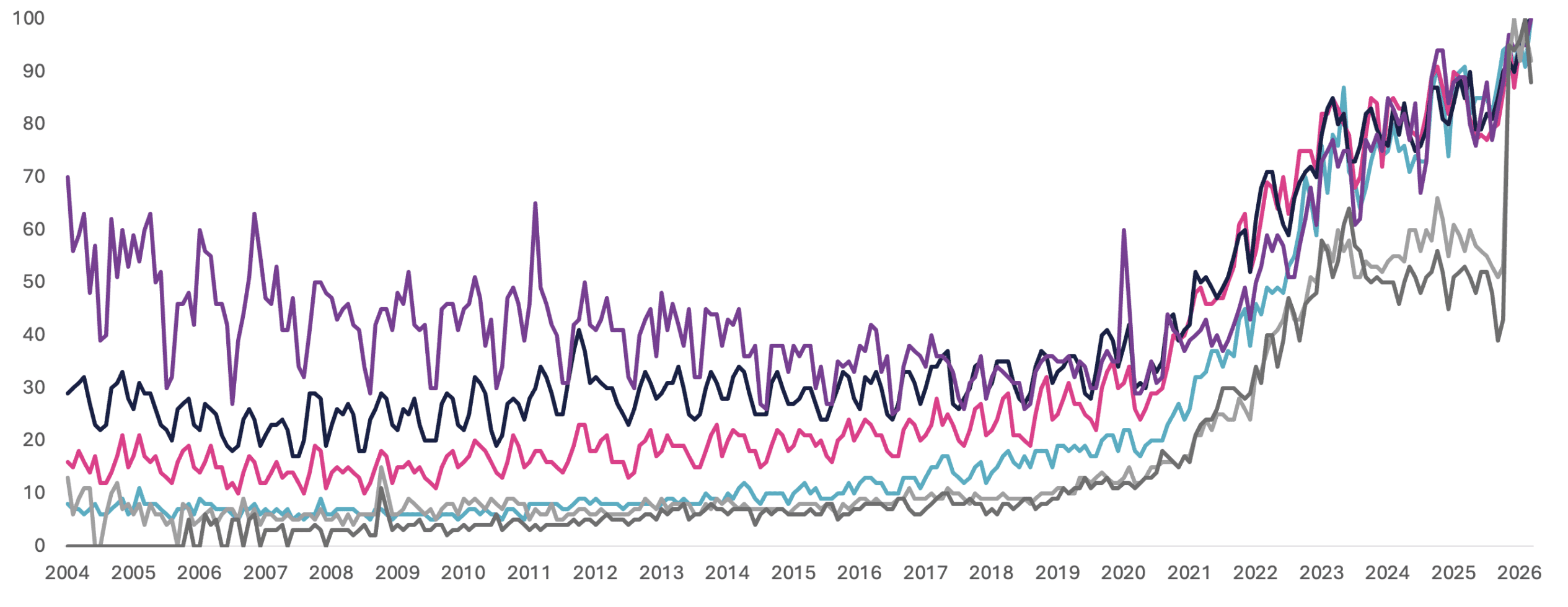
Source: Google Trends. Relative search interest 0-100; 100 = peak interest over full period. Values of 0 indicate insufficient data. Monthly, Jan 2004-Mar 2026.
What is driving this?
The causes of this rise have been subject to considerable debate, with multiple factors identified: the impact of the COVID-19 pandemic on self-awareness and mental health referrals; the pervasive influence of social media; the particular role of TikTok in raising awareness among adolescents [3] has normalised conversations about neurodivergence and accelerated self-referral; and the cascade effect within families once one member is diagnosed, given the strong genetic basis of the condition [4].
There is a substantive debate about whether this rise reflects chronic previous underdiagnosis now being corrected, or at the opposite end of the spectrum, overdiagnosis and overtreatment. The available international evidence suggests both phenomena co-exist: genuine under-diagnosis in populations historically excluded from clinical attention – women, adults, and ethnic minorities – sits alongside concerns about diagnostic inflation in some settings.
Such is the scale of this debate in the UK that two national taskforces have been formed: the Independent ADHD Taskforce, which reported in two parts in 2025 [5,6], and again in 2026, and the government’s formal review of mental health, ADHD and autism services launched in December 2025.
The global picture: A consistent treatment gap
In the UK, the official estimate is that 4.4% of the population, or approximately 2.5 million people, have ADHD, with 25% being children and 75% being adults over 25 [7,8]. Yet diagnosed and treated rates remain far below this benchmark everywhere outside North America. With the exception of the US (~10.5%) and Canada (~5.8%), every comparable country falls short of true prevalence – many dramatically so [9]. England sits at approximately 2.3%, meaning that fewer than half of those estimated to have the condition are currently receiving any treatment.
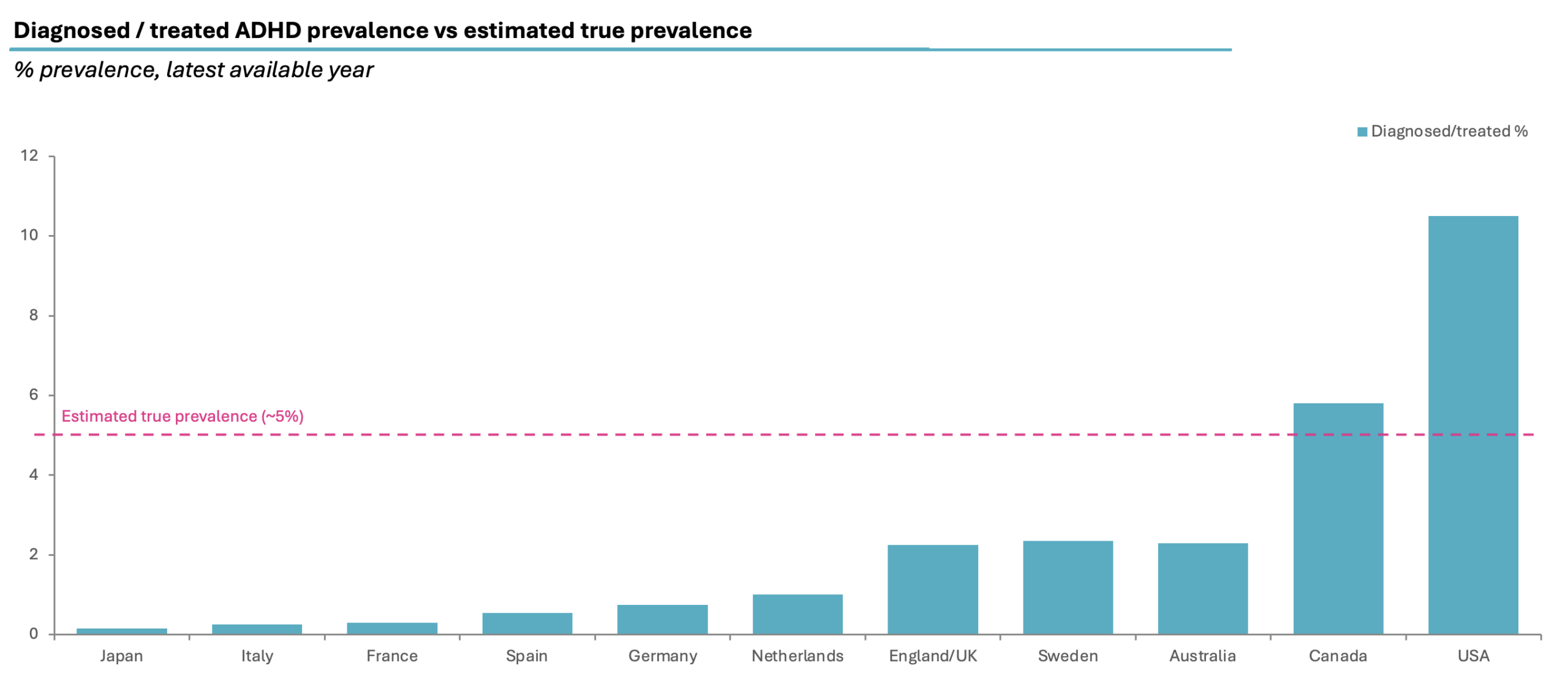
Exhibit 2. Diagnosed / treated ADHD prevalence versus estimated true prevalence. Source: CF analysis of NHS England; McKinchie et al. 2023; AIHW 2023/24; Lancet Regional Health Europe 2026; Lancet Psychiatry 2018. Notes. Japan: amphetamines not licensed; methylphenidate only from 2000; diagnosis culture heavily stigmatised (~0.1–0.2%). Italy: limited national data; estimate from Lancet Psychiatry 2018 regional aggregates. Spain: Lancet Regional Health Europe 2026 (SIDIAP primary care data); children rising but adults still low. Australia: AIHW 2023/24 national data – sharp acceleration post-2019 mirrors UK trajectory. All-population rates shown where available; some figures are children-only proxies where adult data unavailable. True prevalence of 5% is a conservative population-weighted benchmark (NICE: 5% children, 3–4% adults).
Prescribing is accelerating everywhere
Around the world, there have been major increases in prescribing levels. Double-digit annual growth has been observed consistently across Europe. England’s ADHD medication prescribing rose by 118% between 2019 and 2024. France grew at approximately 18% per annum; Spain and Italy at 18–20%; Sweden at 22%. Everywhere outside the US and Canada – which have been at far higher absolute prescribing levels for decades – is now catching up, suggesting the treatment gap is genuinely narrowing, albeit from a very low base. The harder question is what comes next: how do health systems sustain treatment at scale while demand continues to grow?
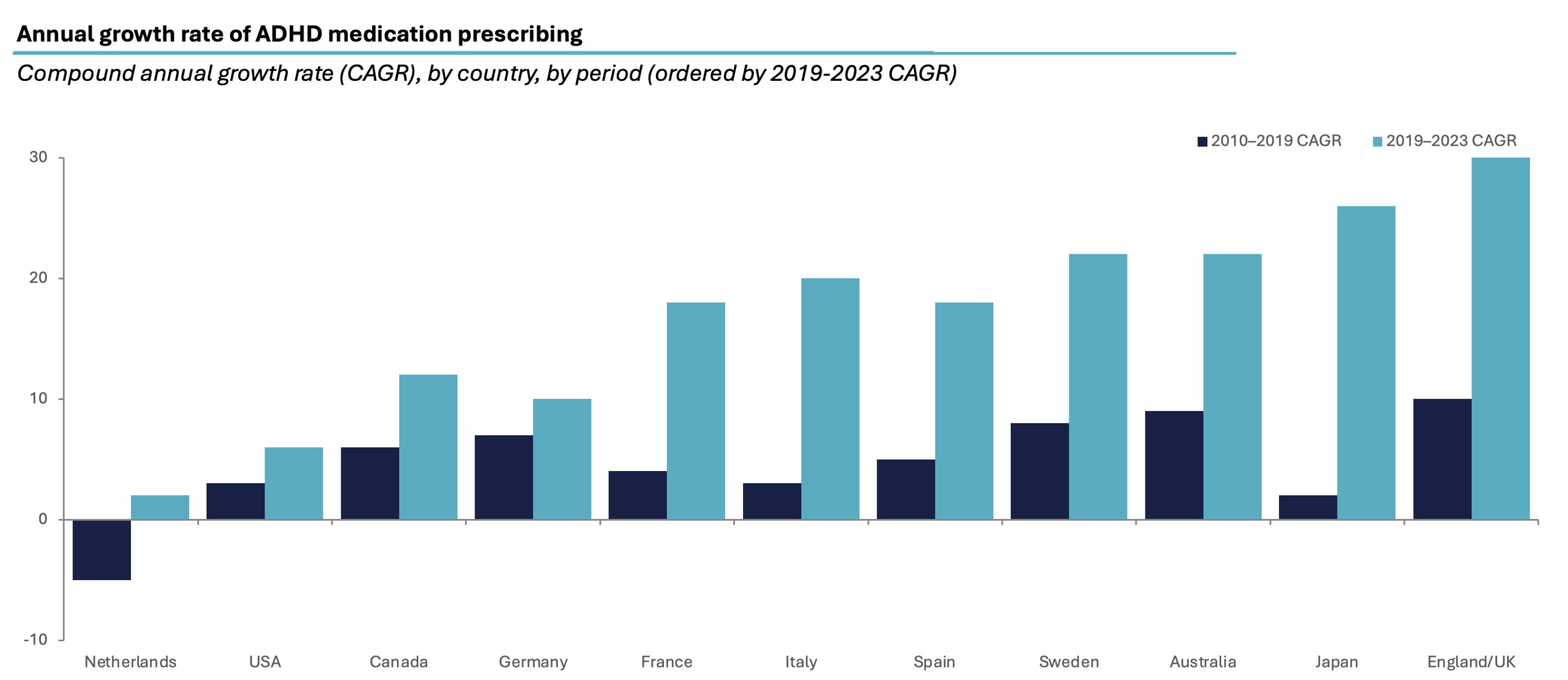
Exhibit 3. Annual growth rate of ADHD medication prescribing. Source: CF analysis of: Germany, Netherlands, Spain, UK: Lancet Regional Health Europe 2026; France, Italy: IQVIA/Corbeau et al. 2023; Lancet Psychiatry 2018; Sweden: national prescription register, PMC 2024; Australia: AIHW 2023/24; Canada: Bolt et al. 2024; USA: CDC / Sibley et al. 2024; Japan: Lancet Psychiatry 2026 regional aggregate; Netherlands decline confirmed by Dutch Youth Act 2010. Bars show annual growth rate, not absolute prescribing level.
Broadly speaking there are two diametrically opposing views on this; One view is that the the treatment gap is genuinely narrowing, albeit from a very low base, with it being common to discuss ADHD and by the realisation of the strong genetic basis of the condition leading to family members getting diagnosed. The opposing view is that we are seeing over diagnosis and over treatment, fuelled by social media, for a condition that some quietly say is not that serious.
Elements of both may well be true. It remains the case there is significant undertreatment and underdiagnosis, which has a major impact on achievement of young people with lasting life impact. This is can be the case across all income bands but is especially in deprived communities. It is also likely that the more affluent are best able to navigate access to diagnosis and assessment.
Regardless of the cause, it is also obvious that the explosion in demand for assessment has already strained health systems, and that is just the start. After initial assessment it takes time to achieve the optimum level of treatment including pharmaceutical and non-pharmaceutical interventions. And even once on stable treatment, it is a condition that is not reversed but managed. This means new demand is not one off but sustained.
This raises serious questions:
- How do health systems respond with public and private provision to this step change in demand?
- Who pays for assessment, optimisation and ongoing treatment?
- How does the evolution of technology influence the prevalence, diagnosis and treatment of ADHD?
- How will the loss of exclusivity of blockbuster ADHD medicines play out in both affordability and new treatment options?
- How are countries across the UK and the EU responding to this?
In part two, we will be deep-diving further into the UK and London landscape, and how the country and capital are tackling the disorder in an already overwhelmed National Health Service.
References:
- Raman, S.R. et al. (2018). Trends in ADHD medication use: a retrospective observational study using population-based databases. Lancet Psychiatry, 5(10), pp.824–835.
- Google Trends data, CF analysis. Data on file.
- Yeung, A. et al. (2022). TikTok and ADHD: A Cross-Sectional Study of Social Media Content Quality. Canadian Journal of Psychiatry, 67(12).
- Faraone, S.V. et al. (2021). The World Federation of ADHD International Consensus Statement: 208 evidence-based conclusions about the disorder. Neuroscience & Biobehavioral Reviews, 128, pp.789–818.
- Report of the Independent ADHD Taskforce: Part 1 (2025). Commissioned by NHS England.
- Report of the Independent ADHD Taskforce: Part 2 (2025). Commissioned by NHS England.
- House of Commons Library (2024). Research Briefing CBP-10551: Attention Deficit Hyperactivity Disorder (ADHD).
- NHS England Digital, ADHD Management Information, MHSDS. Available at: https://digital.nhs.uk/data-and-information/publications/statistical/mi-adhd
- Raman, S.R. et al. (2018). Trends in ADHD medication use: a retrospective observational study using population-based databases. Lancet Psychiatry, 5(10), pp.824–835.
About CF
CF is a leading consultancy dedicated to making an enduring impact on health and healthcare. We work with leaders and frontline teams to improve health, transform healthcare, embed life science innovation and boost growth through investment. With unmatched access to UK healthcare data and award-winning data science expertise, our team are a driving force for delivering positive and meaningful change.
About the authors

Ellen Teesdale
Ellen is the Business Development Manager for Health Investing, working to expand CF’s work and expertise into the private sector. She founded and led the firm’s healthcare practice, managing a diverse range of clients to facilitate the successful integration of innovation into healthcare systems, such as cancer therapeutics and novel biopharmaceuticals.

Frederick Bennett
Freddie is a Consultant at CF, bringing over 8 years of NHS experience spanning clinical practice as a Physiotherapist and operational management. Throughout his career, he has led and worked within teams focused on cost improvement programmes and service efficiencies. His work spans acute collaboration and group model development, large-scale value and efficiency programmes, and national digital infrastructure rollout.

Ben Richardson
Ben Richardson is a Managing Partner at CF, leading Life Sciences and Data Innovation. With two decades of experience, he has worked with health systems and life sciences companies globally, focusing on strategy, transformation, and development. Ben has contributed to primary care, diabetes, cardiovascular, cancer, mental health, and population health management. Since 2014, he has helped CF become an award-winning healthcare company in management consulting and data services.

Vernon Baxter
Vernon is an Associate Partner at CF, connecting leaders in private equity, healthcare and banking with the team at CF. Vernon brings extensive market intelligence to the team, who advise clients on commercial and operational due diligence, value creation and growth strategy.