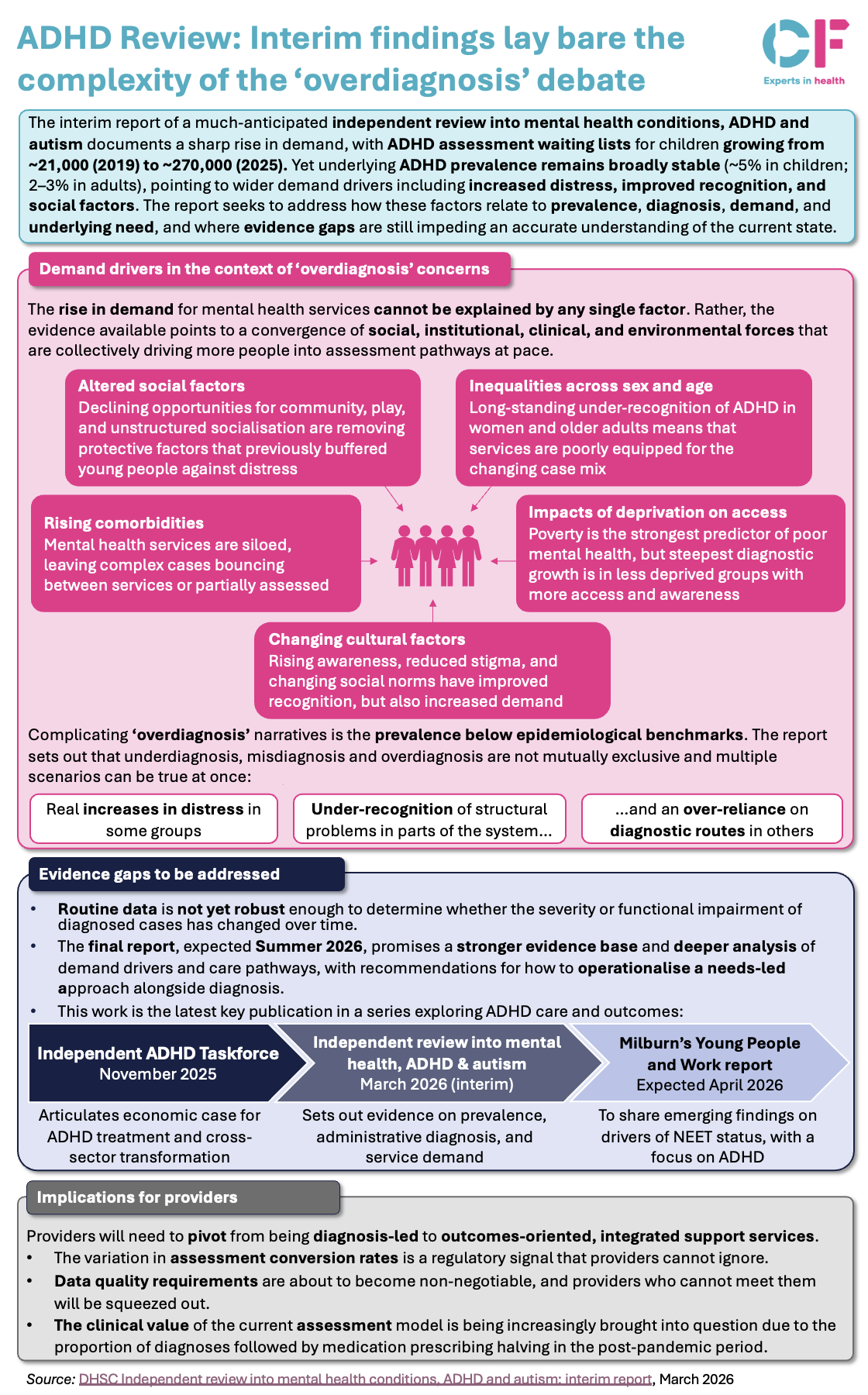
Amid growing debate around ADHD ‘overdiagnosis’, the UK Government’s Independent Review into Mental Health Conditions, ADHD and Autism has published its interim report, examining how converging demand drivers are reshaping care.
The report finds a system under sustained pressure, with demand outpacing capacity and many unable to access timely, appropriate support. Crucially, it highlights that underdiagnosis, misdiagnosis and overdiagnosis are all occurring simultaneously across different groups, pointing to a complex, uneven system rather than a single trend.
Several key insights emerge:
Taken together, the findings point to a system heavily reliant on diagnosis and specialist pathways, which is increasingly unsustainable. For providers, this has clear implications: a shift away from diagnosis-led models toward outcomes-oriented, integrated support; growing regulatory scrutiny of assessment quality and conversion rates; tightening data requirements; and emerging questions over the clinical value of current assessment-to-treatment pathways.
This publication sits within a broader policy movement, following the NHS England ADHD Taskforce review and ahead of Alan Milburn’s forthcoming Young People and Work report, which is expected to highlight ADHD as a key factor in rising NEET rates. The direction of travel is clear: future reform will focus on earlier, needs-based support that reduces reliance on diagnosis as the primary gateway to
See the full snapshot below: