This week our Life Sciences team was in Vienna for ISPOR Europe 2026, the main annual meeting for Europe’s health economists, HTA bodies, payers and industry. Ben Richardson, Ioannis Katsoulis and Ben Wetherell presented across 8 different topics, two of them with our partners the ABPI and Medlior. Between sessions, they spent four days in symposia, poster halls and conversations with people across pharma and health systems.
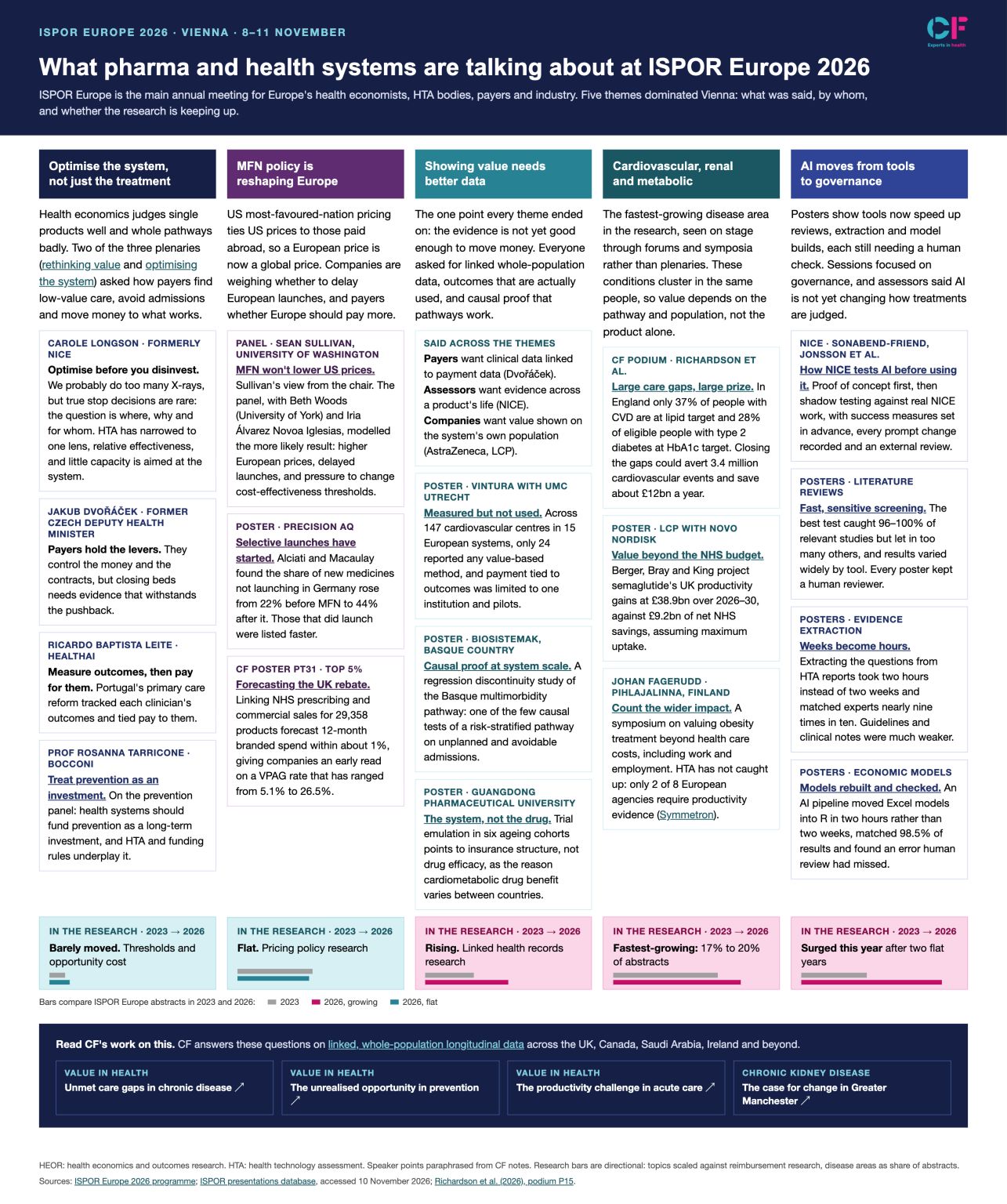
Here is what we learned. Five themes ran through the week, and our snapshot sets out who said what and whether the research is keeping up. The short version: the conversation has moved from the value of a single medicine to the value of the whole system it sits in, and the evidence to support that shift is still catching up.
Click to enlarge
1. Optimise the system, not just the treatment
Two of the three plenaries, on rethinking value and optimising the system, asked how payers find low-value care, avoid admissions and move money to what works. Carole Longson, formerly of NICE, put it plainly: HTA has narrowed to one lens, relative effectiveness, and little of its capacity is aimed at the system. Jakub Dvořáček, former Czech deputy health minister, reminded the room that payers hold the levers but need evidence that withstands the pushback when they close beds.
The research has barely moved. Abstracts on thresholds and opportunity cost were little changed between 2023 and 2026, so the question is running ahead of the evidence. Our healthcare value framework poster (HSD26) is one attempt to close that gap. It builds on our Value in Health series with the NHS Confederation, including our work on the productivity challenge in acute care. Rosanna Tarricone of Bocconi argued that prevention should be funded as a long-term investment, which is the case our report on the unrealised opportunity in prevention puts in numbers.
2. MFN policy is reshaping Europe
US most favoured nation (MFN) pricing ties what the US pays for medicines to prices paid abroad, so a European price is now effectively a global price. Companies are weighing whether to delay European launches, and payers whether Europe should pay more. A panel chaired by Sean Sullivan of the University of Washington modelled the more likely result: higher European prices, delayed launches and pressure on cost-effectiveness thresholds. A Precision AQ poster found the share of new medicines not launching in Germany rose from 22% before MFN to 44% after.
Yet research on pricing policy has been flat since 2023. The policy is moving faster than the evidence about its effects, and for patients waiting on new treatments that uncertainty has a cost.
For UK launch teams, predictability now matters as much as price. Our poster with the ABPI (PT31), selected in the top 5% of submissions, links NHS prescribing and commercial sales data to forecast branded medicines spend 12 months ahead to within about 1%. That gives companies an early read on a VPAG rate that has ranged from 5.1% to 26.5%.
3. Showing value needs better data
This was the point every theme ended on: the evidence is not yet good enough to move money. Each group wants something different. Payers want clinical data linked to payment data. Assessors want evidence across a product’s whole life. Companies want value shown on the health system’s own population.
The posters showed how far there is to go. Vintura and UMC Utrecht found that of 147 cardiovascular centres across 15 European systems, only 24 reported any value-based method. Biosistemak’s study of the Basque multimorbidity pathway was one of the few causal tests of a whole pathway at system scale. Research using linked health records is rising, which is encouraging.
Our view is that linked, whole-population data can answer all three asks at once. Our poster RWD36 linked national prescribing with hospital activity and costs for 57.3 million people in England, and found that people with multiple conditions account for 28% of the £21.3bn spent on branded medicines. With Medlior (RWD116), we showed that health data in Alberta and England line up well enough to run the same study in both. Read more about our partnership with Medlior and why the data is there but often unused.
4. Cardiovascular, renal and metabolic
This was the fastest-growing disease area in the research, up from 17% to 20% of abstracts since 2023, though it was discussed more in forums and symposia than on the main stage. GLP-1 medicines are part of the reason. These conditions also cluster in the same people, so a medicine’s value depends on the pathway and the population, not the product alone.
Ben Richardson’s podium talk (P15) put numbers on the gap. In England only 37% of people with cardiovascular disease are at their lipid target, and 28% of eligible people with type 2 diabetes are at their HbA1c target. Closing those gaps could avert 3.4 million cardiovascular events and save about £12bn a year. Johan Fagerudd of Pihlajalinna made the case for counting obesity treatment’s wider impact on work and employment, yet only two of eight European HTA agencies require productivity evidence.
Kidney disease shows the same gap. Our Greater Manchester analysis with Health Innovation Manchester found that chronic kidney disease has no dedicated Quality and Outcomes Framework indicators, while cardiovascular disease has 16, and only 25% of eligible patients are prescribed SGLT2 inhibitors.
5. AI moves from tools to governance
AI research surged this year after two flat years. The posters showed tools that now speed up literature reviews, evidence extraction and model builds. Extracting the questions from HTA reports took two hours instead of two weeks, and one pipeline rebuilt Excel models in R in two hours, matched 98.5% of results and found an error human review had missed. Every one still needed a human check.
The sessions, meanwhile, focused on governance. NICE set out how it tests AI before use: proof of concept, shadow testing against real work, success measures set in advance and an external review. Assessors said AI is not yet changing how treatments are judged.
Our own evaluation of an AI tool that ranks patients waiting for planned surgery by risk (MSR65) points the same way. The main barrier was the lack of a clear use and benefits case, and the value came when the tool was built into NHS Federated Data Platform workflows rather than used on its own.
What this means
The five themes share one thread. Health systems want to know what a medicine is worth across their whole population, under tighter budgets and less predictable pricing, and the evidence to answer that is not there yet.
We think the companies best placed for 2027 launches will build their value case on linked population data from the start, rather than retrofitting it after approval. Partnership with the NHS is one route: our analysis with the ABPI linked NHS-industry partnerships with better adherence to NICE guidance and improved outcomes for patients.
Thank you to everyone who came to our podium talk and posters in Vienna. We will be publishing our posters, and podium slides from Vienna will be available on our website shortly. Follow CF on LinkedIn to be the first to see them.