The final report of the Milburn Review into young people not in education, employment, or training (NEET) was published on 17 November 2026. From a Welfare State to a Working State acts as a broad-based manifesto for a total overhaul of employment policy for young people. The report proposes a new Youth Opportunity Service (YOS) in every place in England, acting as a single contact point for young people to enable their participation in education and employment.
In the health sector, the Milburn Review looks to overhaul the way that young people access health support. The YOS becomes an entry point to mental and physical health support, with ICBs commissioning the health services that YOS users most need to enable their re-entry to the workforce.
Key points
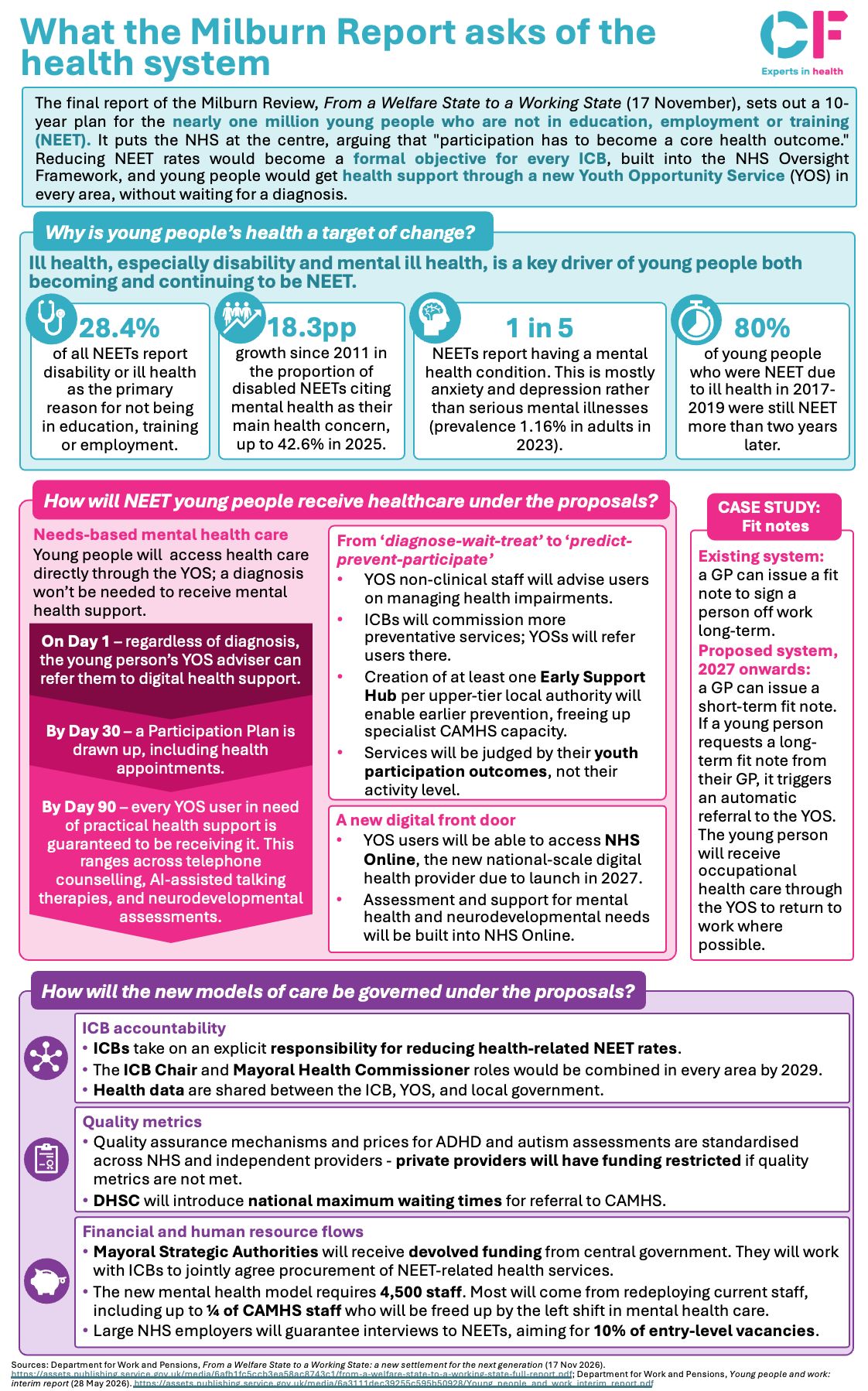
See the full breakdown in our snapshot below. Click the image to enlarge.
What this means for the NHS
The Milburn Review asks the NHS to treat a young person’s return to education or work as a health outcome, and to share responsibility for it with local government and the new Youth Opportunity Service. For integrated care boards (ICBs), that is a significant shift in accountability. Health-related NEET rates would sit in the NHS Oversight framework and Planning Guidance. ICBs would also have to explain poor performance, produce improvement plans and face intervention and services would be judged on whether young people go on to participate, rather than on the volume of activity they deliver.
The case for change is strong. Over a quarter of young people who are NEET (28.4%) cite disability or ill health as the main reason, and 80% of those who were NEET due to ill health between 2017 and 2019 were still NEET more than two years later. For a young person in that position, getting help on day one, without first waiting for a diagnosis, could change the course of the next decade of their life.
The proposals also carry real delivery risk. Around 4,500 staff would be needed, mostly redeployed or upskilled from existing mental health services, which raises the question of what happens to current waiting lists. The digital front door depends on NHS Online, which is not due to launch until 2027. Sharing data between ICBs, local government and the YOS will need clear governance and the trust of young people themselves. This would mean setting the purpose in law, sharing only the minimum information needed, and keeping individual case support separate from planning analysis. Central government would share data with councils and strategic authorities using a common identifier. Legislation would follow to allow information to be shared once and used across services.
Joint commissioning with Mayoral Strategic Authorities is new ground for most systems.
The government’s response will settle the detail, but CF’s view is that ICBs do not need to wait for it to start preparing. Three steps would put systems in a stronger position: understanding the scale and drivers of health-related NEET in their population; mapping the current youth mental health and neurodevelopmental offer against the “predict, prevent, participate” model; and starting conversations now with local authority and mayoral partners about shared data and joint commissioning.
To read the full Millburn review, click here.