In September 2026, the Health Foundation’s NHS Productivity Commission published Breaking the cycle: how to build a more productive NHS. Its central conclusion is that the NHS is not set up to deliver sustained productivity growth. The Commission defines productivity as better outcomes and patient experience from the resources available and finds that improvement currently tends to happen despite how the NHS is run. This is a report about the conditions NHS organisations work in, not about asking staff to work harder.
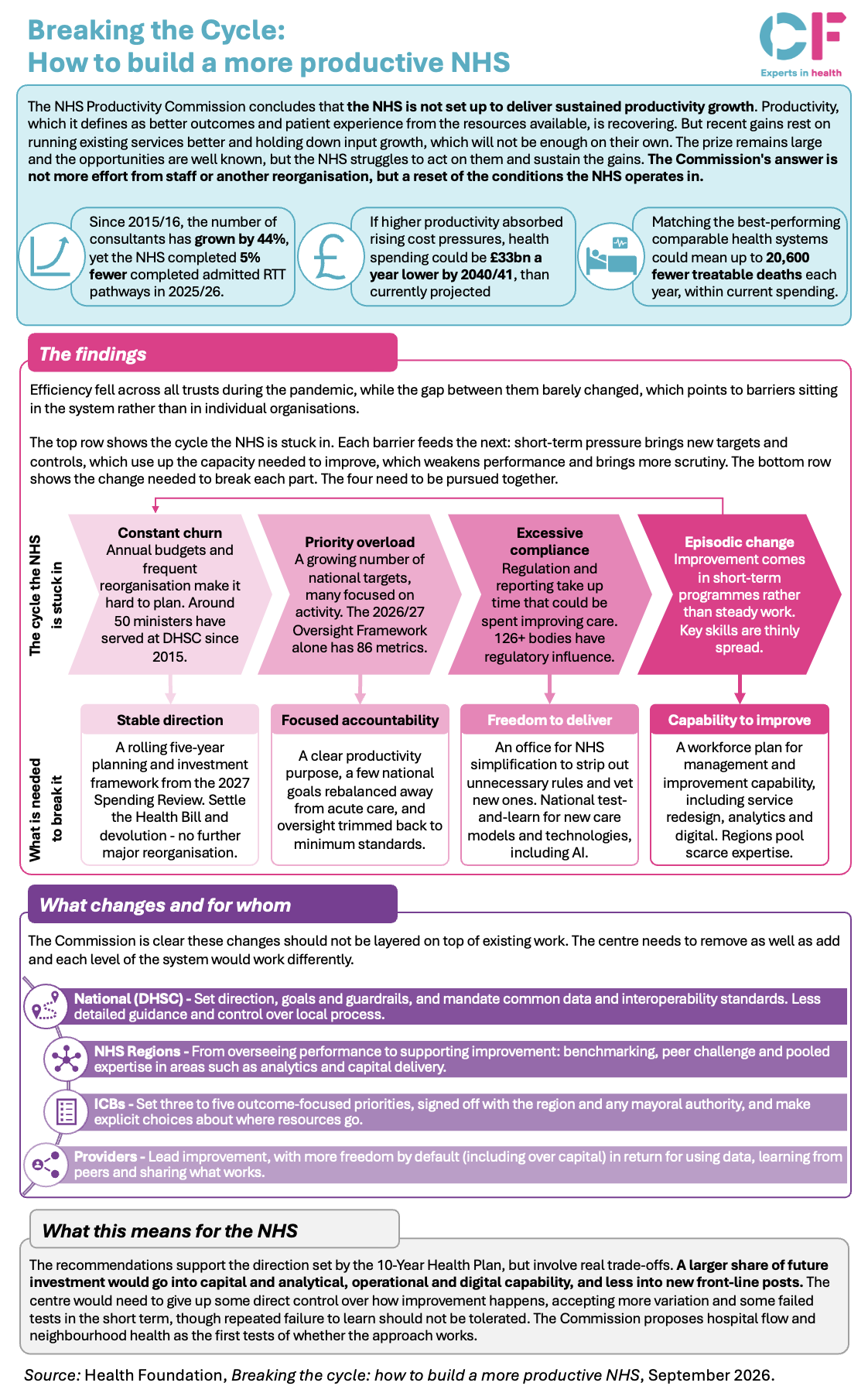
Productivity is recovering. NHS trust productivity grew by 3.5% in 2025/26, faster than the government’s 2% annual target. But the Commission finds these gains rest on running existing services better and holding down input growth, and will not be enough on their own, because structural constraints limit how far this can go. Since 2015/16, the number of consultants has grown by 44%, yet the NHS completed 5% fewer completed admitted RTT pathways in 2025/26. The Commission points to beds, theatres, diagnostics and administrative support not keeping pace, with capital per worker in NHS trusts falling by 30% between 2010/11 and 2024/25, alongside factors such as rising patient complexity.
The prize remains large. Matching the best-performing comparable health systems could mean between 18,500 and 20,600 fewer treatable deaths each year within current spending. If higher productivity absorbed rising cost pressures, health spending could be around £33 billion a year below its projected path by 2040/41, in today’s prices.
The key points
The Commission identifies four barriers that feed one another: constant churn, priority overload, excessive compliance and episodic change. Short-term pressure brings new targets and controls, which use up the capacity needed to improve, which weakens performance and brings more scrutiny. Its 10 recommendations are grouped around four conditions to break that cycle, which need to be pursued together:
- Stable direction. A rolling five-year planning and investment framework from the 2027 Spending Review, with firm assumptions for three years and indicative ones for two, aligning revenue, capital, workforce, digital and payment policy. Government should settle the Health Bill and devolution, then avoid further major reorganisation.
- Focused accountability. A clear productivity purpose for the NHS, backed by a small number of national goals, rebalanced away from acute care, and clear minimum standards. Oversight would be trimmed back to those standards, with intensive intervention reserved for significant or persistent failure. Local systems would be held to account for outcomes rather than activity, supported by better outcomes measurement, including PROMs and PREMs.
- Freedom to deliver. A new office for NHS simplification to strip out duplicative or disproportionate requirements and challenge new ones before they reach the service, alongside a national test-and-learn approach for new care models and technologies, including AI.
- Capability to improve. A workforce plan for management and improvement capability, including service redesign, demand and capacity management, analytics and digital skills. Regions would pool scarce expertise such as analytics and capital delivery, and data and interoperability standards would become binding on NHS organisations and suppliers.
See our snapshot for a full breakdown:
Click to enlarge
What it means for the NHS
The recommendations would not require another restructure and support the direction already set by the 10-Year Health Plan. But they involve real trade-offs. The centre would give up some control over how improvement happens, accepting more variation and some failed tests in the short term, although repeated failure to learn should not be tolerated. A larger share of future investment would go into capital, data, digital and management capability rather than more front-line posts. For ICBs and providers, this means more freedom in return for clearer priorities, better outcome data and a willingness to learn from peers. The Commission proposes hospital flow and neighbourhood health as the first tests of whether the approach works.
To read the full NHS Productivity report, click here.