The independent review into mental health conditions, ADHD and autism, published by the Department of Health and Social Care on 9 October 2026, concludes that diagnosis should no longer be the gateway to support.
The Secretary of State for Health and Social Care commissioned the review in December 2025 to understand why prevalence and demand are rising, and whether diagnosis and treatment improve outcomes. Professor Peter Fonagy chaired it, with Professor Sir Simon Wessely and Professor Gillian Baird as vice-chairs. Its interim report, published on 31 March 2026, set out the evidence so far, including its gaps and uncertainties.
The final report builds on that evidence and recommends a shift from a diagnosis-dependent system to a “needs-led plus diagnosis” model, in which support begins when need is recognised and diagnosis is used where it adds value.
The key points
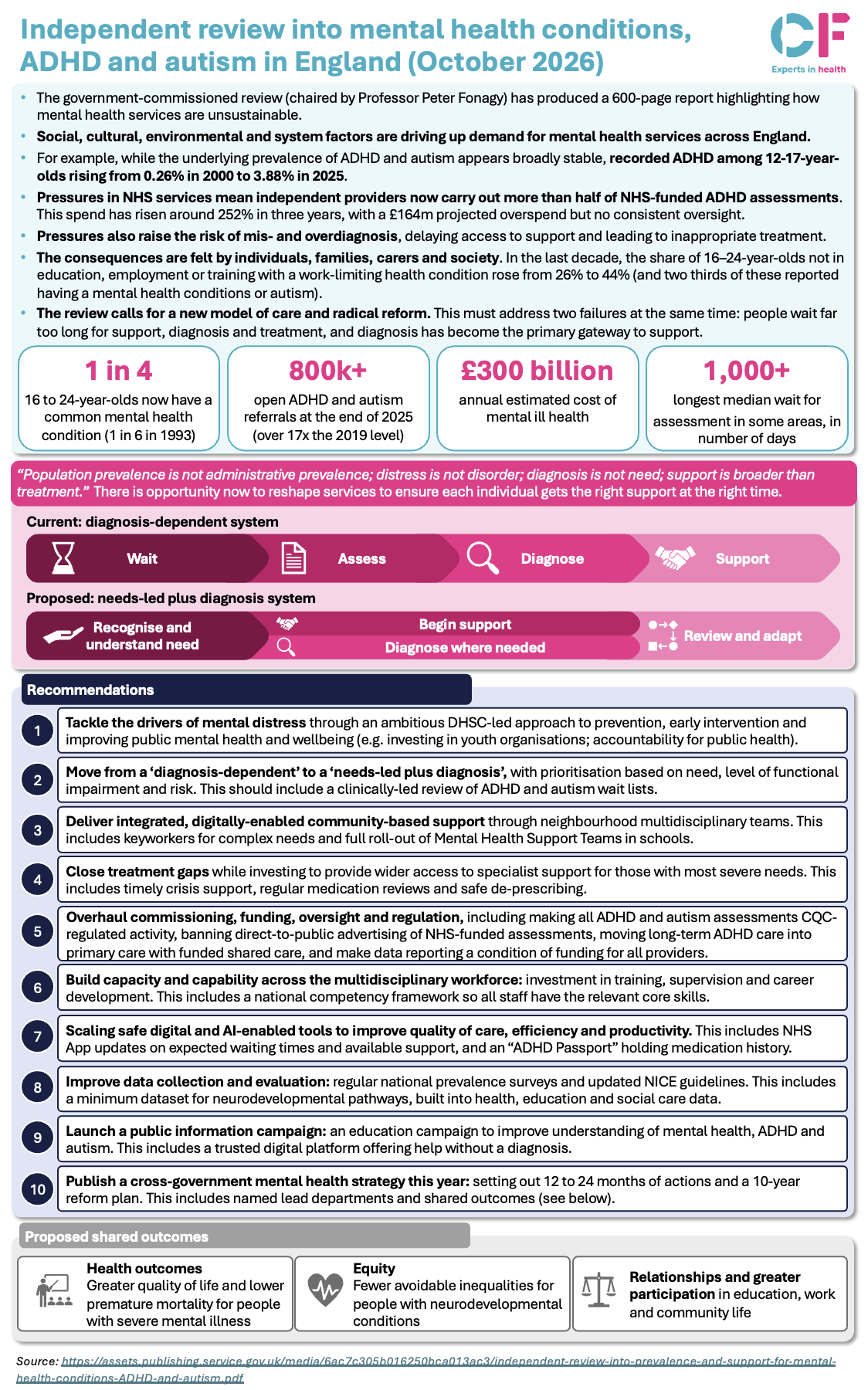
Need and recognition are both rising, and a system built around diagnosis cannot keep pace. The review’s main findings:
See our snapshot for a full breakdown (Click to enlarge).
What it means
If implemented, the review would shift the focus from clearing diagnostic waiting lists to meeting need earlier, across health, education and social care. Its 10 recommendations range from national prevention and integrated neighbourhood teams for people from birth to 25, to workforce, regulation, digital tools and data. A cross-government mental health strategy is due this year, with 12 to 24 months of actions and a 10-year reform plan.
For the NHS and its partners, the main implications are:
- Support starts earlier and in more places. A “no wrong front door” approach brings schools, GPs, family hubs and employers closer to the point where support begins.
- Diagnosis changes role. It remains available where it is needed, but is no longer the only route to help.
- Commissioning and regulation change. The review proposes integrated, outcome-based commissioning, CQC regulation of ADHD and autism assessments, and a ban on public advertising of NHS-funded assessments.
- Data becomes central. Regular national prevalence surveys and a minimum dataset for neurodevelopmental pathways would give a shared picture across health, education and social care.
The change will also need careful explanation. Families who have waited years for an assessment may see a needs-led model as diagnosis being rationed, so the promise of diagnosis “where needed” will matter as much as the new routes to support.
To read the DHSC’s full Independent Review, click here.
Sources: Department of Health and Social Care Independent review into mental health conditions, ADHD and autism: Final report