CF presented at the Ethical Medicines Industry Group quarterly meeting last month, on what the NHS 10 Year Plan and the wider UK health agenda mean for small and mid-size pharmaceutical companies. The session drew out three conclusions that are, individually, not new. Put together, they describe a commercial environment that most mid-cap pharma boards have not yet fully absorbed.
The buyer has changed
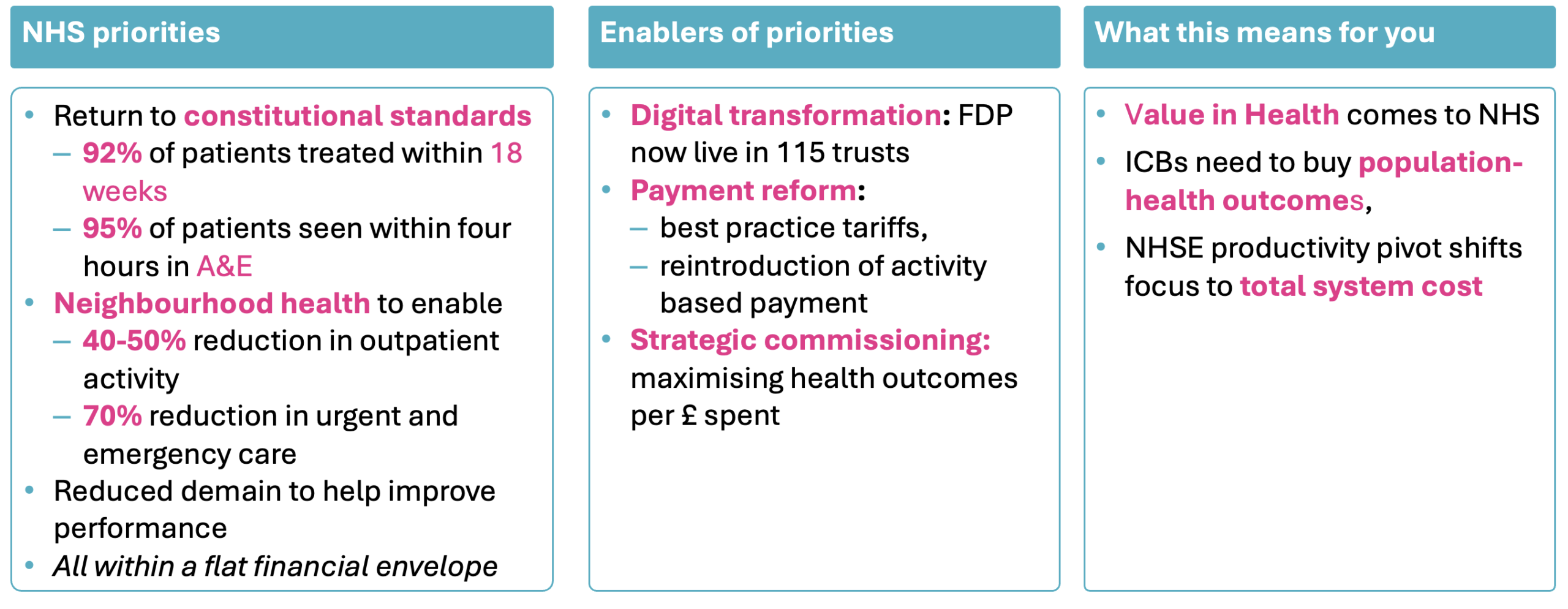
The first point is a paradigm shift as ICBs are now being asked to commission for population-health outcomes inside a flat financial envelope, with constitutional standards (92% of patients treated within 18 weeks, 95% seen within four hours in A&E) as the visible performance test. Neighbourhood health is the vehicle, with ambitions of a 40 to 50% reduction in outpatient activity and a 70% reduction in urgent and emergency care. Strategic commissioning is the underlying logic: maximise health outcomes per pound spent. The Federated Data Platform, now live in 115 trusts, provides the operational backbone to support this transition.
What this means in practical terms for a pharmaceutical commercial team is that the unit of value the NHS is buying has changed. ICB finance directors are not buying a mechanism of action. They are buying addressable healthcare resource use against a population in their plan. CF’s analysis of the population segmentation, using our ©Health Strata model, shows why this matters: roughly 25% of the population accounts for 86% of hospital costs, and chronic disease and multi-morbidity dominating that segment.
Following patient-level flows through the system suggests around 70% of A&E attendances and 50% of outpatient activity could plausibly be supported in a different setting. That is not a comment on clinical decisions. It is the size of the prize for anyone who can help the NHS shift demand into a more cost-effective configuration.
The buyer has changed. Portfolios built for the old buyer will underperform against the new one.
VPAG and the patent cliff: structural, not cyclical
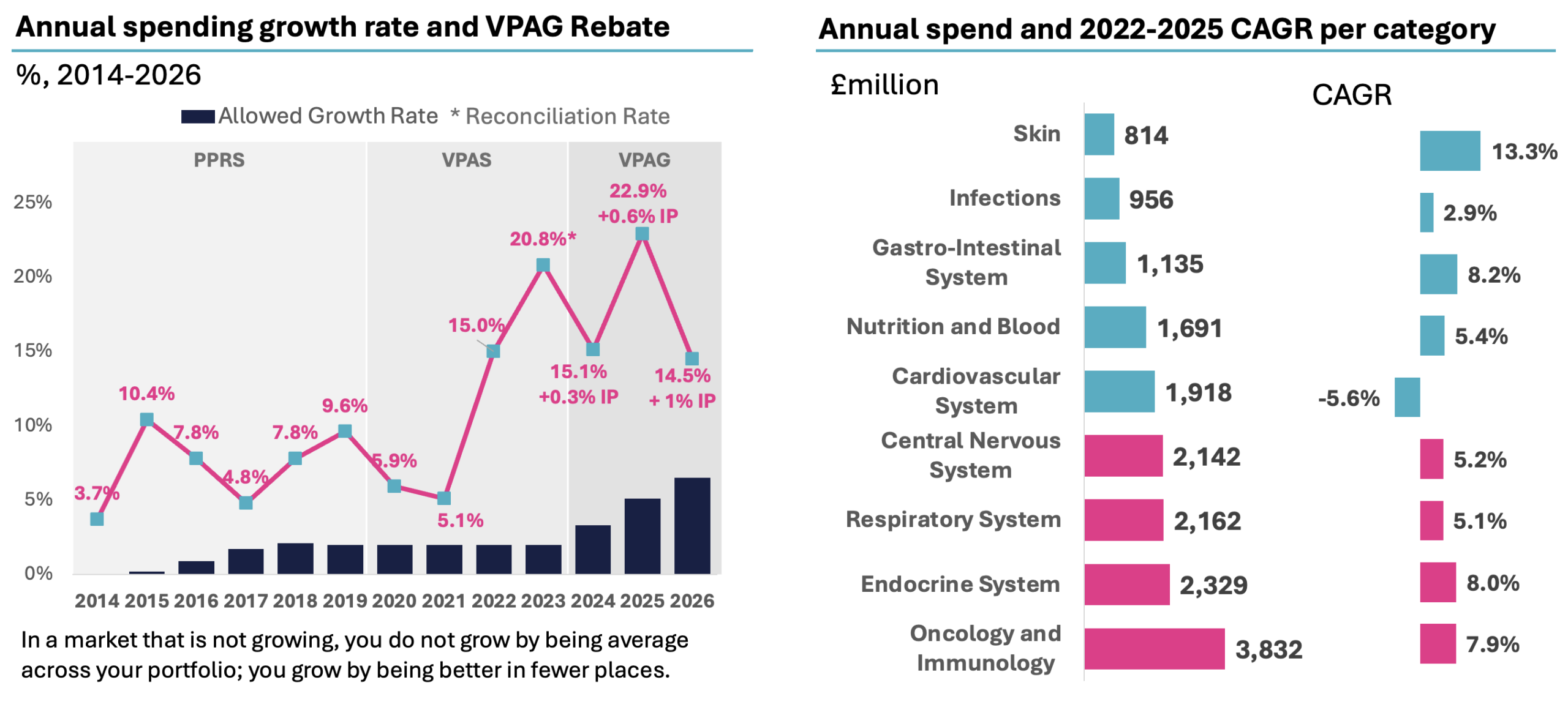
VPAG has escalated, and EMIG members with branded products already feel it in their P&L. But the diagnosis matters. What is less well understood is that the rebate is being driven by growth that is heavily concentrated in a small number of therapy areas. Our analysis of around 1,100 medicines over eight years shows oncology and immunology accounting for about 33% of growth alone, with endocrine, respiratory and CNS together making up most of the rest. In a market that is not growing in aggregate, you do not grow by being average across your portfolio, but instead by being better in fewer places. The rebate escalator, at a 22.9% peak for 2025, is the market signal that average is not enough.
Layered on top is the 2026 to 2030 patent cliff. Around 56% of the £9 billion UK branded sales base is in therapy areas losing exclusivity from 2026, with oncology alone at £3.06 billion of value at risk against £0.64 billion still protected. The impending cliff is three to four times larger than the 2011/12 cliff, and it lands on complex biologics rather than small-molecule primary care products. Biosimilar uptake is slower in those categories, but the absolute exposure is much higher.
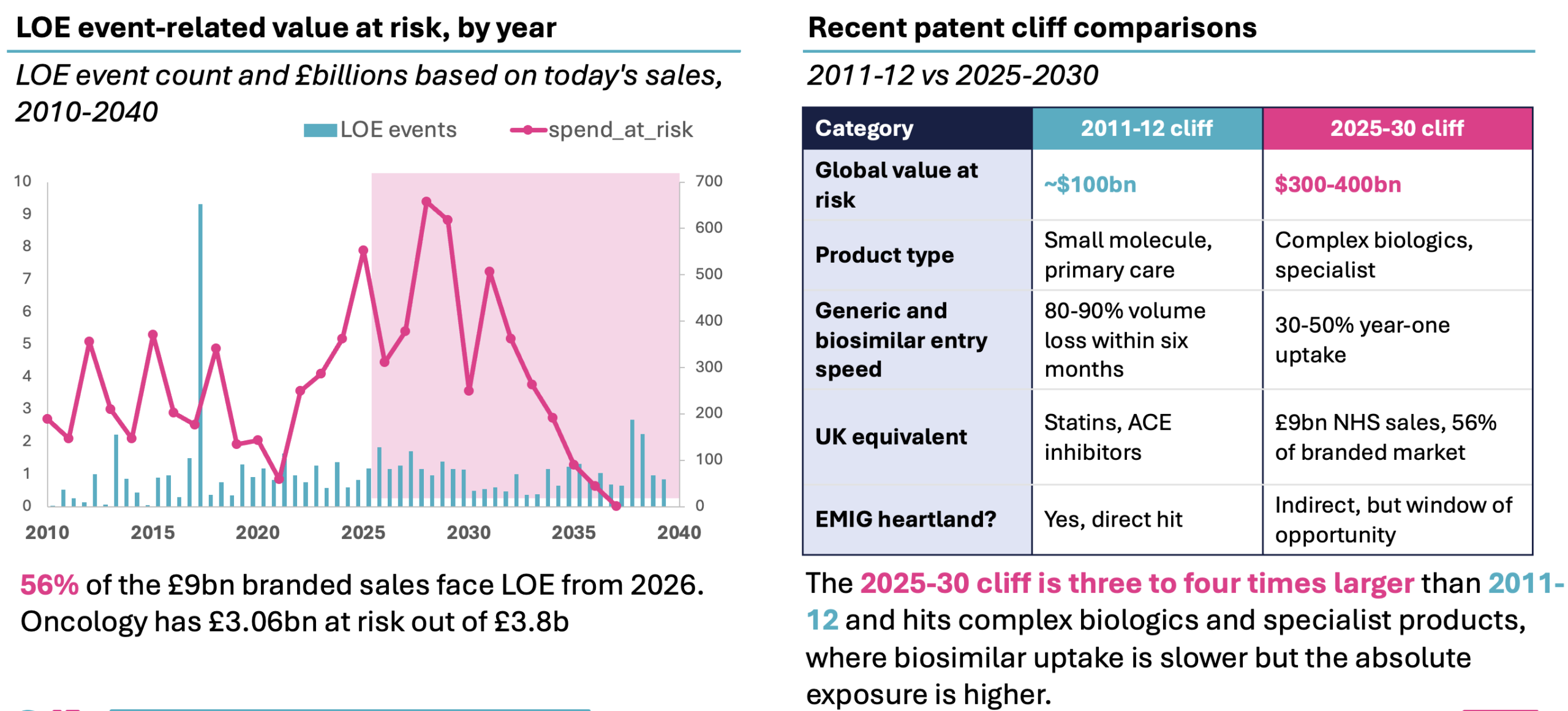
For medium and small size pharma specifically, the squeeze is structural rather than cyclical. The industry’s instinctive response, doubling down on R&D and M&A in oncology, and the other concentrated growth areas (e.g., GLP-1), will keep the sales increase momentum despite measures to contain the VPAG rebates going forward. Also the US-UK pricing agreement, which commits to lifting UK medicines spend from around 0.3% to 0.6% of GDP, implies both volume and price growth in a system that is not currently configured to deliver volume. The route through is not the headline price negotiation but a clear focus on value.
NICE approval is not NHS access
A NICE positive recommendation used to be a key access decision. In the chronic disease space in 2026, it is a necessary but a visibly insufficient condition.
The clearest illustration is GLP-1 therapy. There are around 12 million patients in England eligible for GLP-1 treatment under current NICE guidance. Approximately 220,000 are on therapy. The gap is not approval but delivery: case finding, prescribing pathways, primary care capacity, the patient identification tooling, the local commissioning conversation. The same pattern shows up across the cardiovascular and metabolic space. Only 37% of CVD patients are on lipid-lowering therapy with cholesterol under threshold. Only 28% of those eligible for type 2 diabetes treatment have HbA1c at optimal levels. Only 65% of dementia patients are diagnosed, and around 5% of those are on AChE inhibitors.
The size of the prize from closing those delivery gaps is large and well evidenced. Our analysis on QOF and CVDPREVENT data suggests that £2.5 billion of CVD spend is addressable simply by closing the gap between the best- and worst-performing ICBs on hypertension control. Treating to NICE-guideline targets on blood pressure, cholesterol and HbA1c takes the CVD figure to £4.8 billion. Add diabetes, CKD and dementia, and the addressable headline could cross £11 billion. The medicines required to close most of that gap are largely already available.
This is what we mean by “from access to uptake”. The commercial proposition that walks into an ICB finance director’s office in 2026 is no longer “here is the molecule, here is the NICE TA, please prescribe”. It is “This is the population identified in your plan, this is the quantifiable variation currently present, this is how we propose to collaborate to address it, and this is an outcomes-based agreement that aligns our interests and shares accountability.”
Three therapy area combinations pass the three tests we use to filter where a credible pharma entrant can win going forward (i.e., growing NHS demand, motivated payer, manageable competition): cardiovascular, respiratory and CKD. Two of those three are areas the top-10 pharma pipeline is actively under-investing in.
What the rest of the day told us
Our session sat alongside three other contributions that, taken together, framed the same problem from different angles.
The MHRA-NICE Aligned Pathway, which launched on 1 April 2026 with 27 companies on board and the first guidance expected this summer and implications of the trade arrangement on NICE’s ICER threshold were discussed, both relevant for any company sequencing UK launches against EU and US timelines. The Aligned Pathway changes the orchestration of evidence generation in a meaningful way, and the threshold debate changes the economics of who can credibly clear it.
The Mackey reset at NHS England and what the neighbourhood health agenda actually translates into operationally in 2026 was discussed as a substantive shift in how NHSE engages with systems and providers. The neighbourhood health vehicle is the place where the demand reductions implied by the 10 Year Plan will succeed or fail. For small and medium pharma commercial planning, the granular question is which neighbourhood health programmes in which ICBs are real, and which are still on a slide.
The Most Favoured Nation and the emerging space for innovative commercial models was discussed, especially how its exposure is structurally harder for small and medium than for large pharma, who have less US footprint to absorb a UK concession that spills globally, and less pricing flexibility on legacy products. The innovative commercial models conversation is where the practical answers are starting to accumulate.
Taken together, the four sessions describe a system in which the regulatory and HTA front door is being redesigned, the NHS operating model is being reset, the commercial framework is being renegotiated under MFN pressure, and the underlying demand patterns are shifting toward chronic disease and population outcomes. All of those moving pieces interact and none of them resolves in a small/medium-pharma-friendly direction by default.
Where this leaves a mid-cap pharma board in 2026
Three moves came out of the session.
First, audit your portfolio against where the NHS is actually buying, rather than against where NICE has approved. Map every product against ICB Joint Forward Plan priorities, QOF 2025/26, CVDPREVENT and equivalent registries. Retire the launches the NHS is not buying. Double down where the QOF signal is loud.
Second, lead with value, not the molecule. ICB finance directors are buying addressable healthcare resource utilisation. The unwarranted-variation number for your therapy area, the £2.5 billion in CVD as the worked example, is more useful in the first conversation than the mechanism of action. Offer outcomes-based contracting before the ICB asks.
Third, build the enablers. Multiple data access routes (DARS, Secure Data Environments, CPRD), case-finding and risk-stratification tools that help PCNs rather than replace them, and a real ICB partnership posture. These are now the price of entry and no longer the differentiator they were three years ago.
Adjusting to where the NHS is actually buying delays the revenue growth most boards have already projected for 2026, but building the evidence base is the main approach that compounds through to 2030.
Thanks to EMIG and to the steering group for hosting a substantive afternoon. CF’s Life Sciences team works with pharmaceutical companies on exactly the questions in this piece, from NHS market access strategy and outcomes-based contracting design to the data infrastructure that supports both. If you would like to discuss what the shift from access to uptake means for your portfolio, please get in touch.
About CF
CF is a leading consultancy dedicated to making an enduring impact on health and healthcare. We work with leaders and frontline teams to improve health, transform healthcare, embed life science innovation and boost growth through investment. With unmatched access to UK healthcare data and award-winning data science expertise, our team are a driving force for delivering positive and meaningful change.
About the authors

Ben Richardson
Ben Richardson is a Managing Partner at CF, leading Life Sciences and Data Innovation. With two decades of experience, he has worked with health systems and life sciences companies globally, focusing on strategy, transformation, and development. Ben has contributed to primary care, diabetes, cardiovascular, cancer, mental health, and population health management. Since 2014, he has helped CF become an award-winning healthcare company in management consulting and data services.

Ioannis Katsoulis
Ioannis is Director for the CF Life Sciences practice, bringing over 12 years of experience in global market access, pricing, and health policy research, with a strong track record of delivering strategic insights across top pharmaceutical and biotech companies. Throughout his consulting career, Ioannis partnered with various functional teams to optimise the value proposition of therapies by demonstration of benefits for patients and healthcare systems.