Emergency departments are a critical component of urgent and emergency care, yet demand now significantly exceeds capacity. England records over 27 million A&E attendances each year, while performance against the 4-hour completion standard (95%) has fallen to 60%. Delays in care frequently extend beyond 12 hours annually.
NHS England has invested in the Model Emergency Department, which standardises how patients are rapidly assessed, streamed and directed to appropriate services within both community settings and acute care. The guidance aims to create consistency in how emergency care is delivered across the country and defines the operational components, patient pathways, and system enablers required to deliver high-quality urgent and emergency care.
Key points
The Model Emergency Department guidance establishes a standardised approach with three main components:
See the full snapshot below:
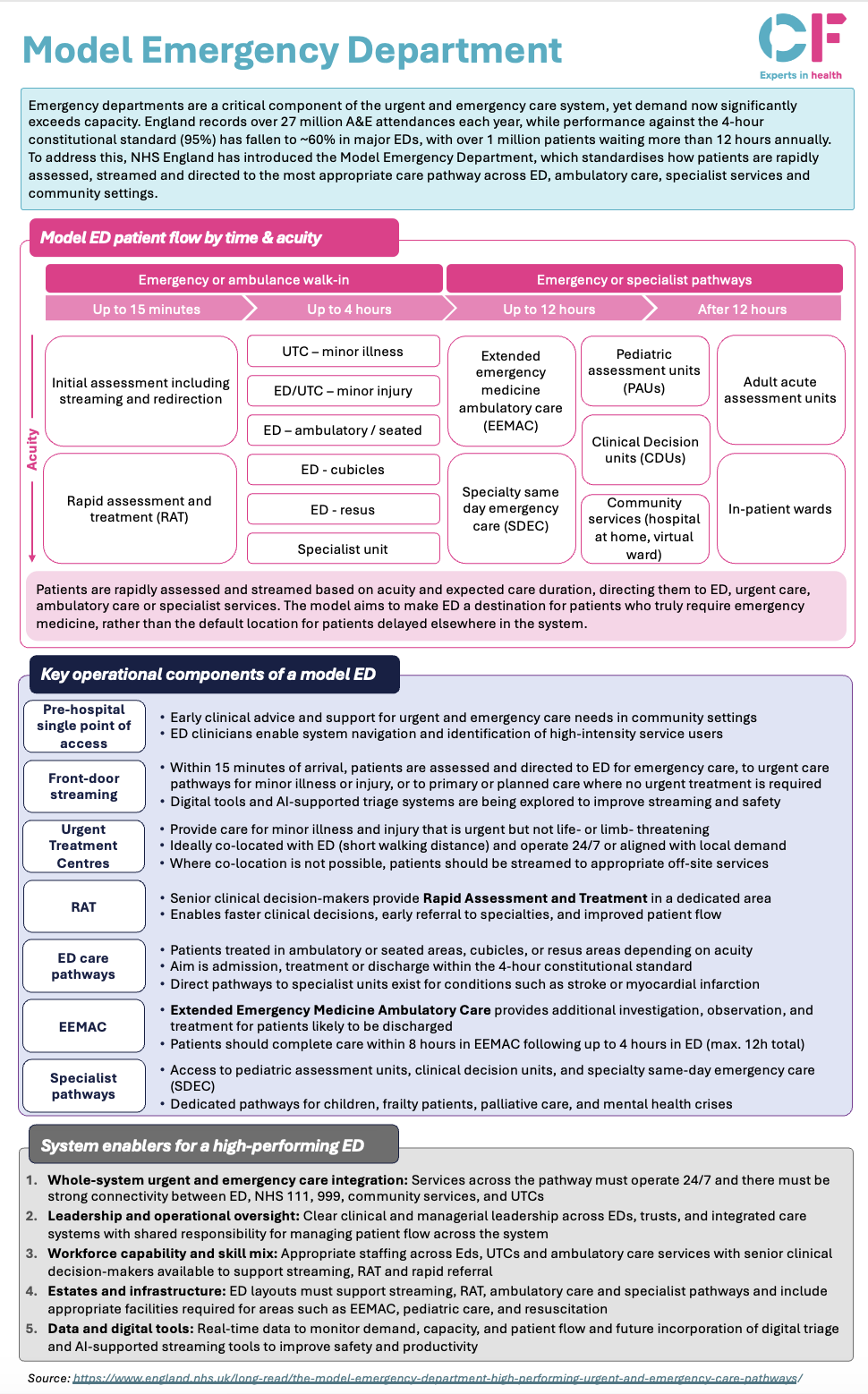
Click to expand
What this means for patients
For patients, the Model ED represents a shift toward faster initial assessment and more appropriate care pathways. Instead of waiting in an emergency department for conditions that could be managed elsewhere, patients will be streamed to the right service within 15 minutes of arrival. Those with minor illness or injury should be directed to Urgent Treatment Centres, which provide care without the wait times associated with busy EDs. Patients requiring emergency care should benefit from dedicated RAT areas that enable faster clinical decisions and quicker discharge or admission.
The guidance also aims to reduce the use of ED as a holding area for patients awaiting beds elsewhere in the system. Extended Emergency Medicine Ambulatory Care provides an alternative for patients who need short-term monitoring but not full admission, potentially reducing time spent in ED.
For patients requiring specialist care, dedicated pathways should mean faster access to the right expertise, whether for stroke, cardiac events, or mental health crises. The emphasis on 24/7 operation across the urgent care system should reduce variation in service availability.
What this means for the NHS
The Model ED is explicitly designed to support achievement of the 4-hour standard, which currently stands at 60% nationally against the 95% target. The guidance provides a framework, but delivery depends on resolving capacity constraints across the entire system, not just within the ED itself.
The Model ED guidance represents NHS England’s attempt to create consistency in emergency care delivery. Implementation will require coordinated action across trusts, ICBs, and system partners, with significant implications for capital investment, workforce, and operational practice.
Read the full Model Emergency Department guidance here.