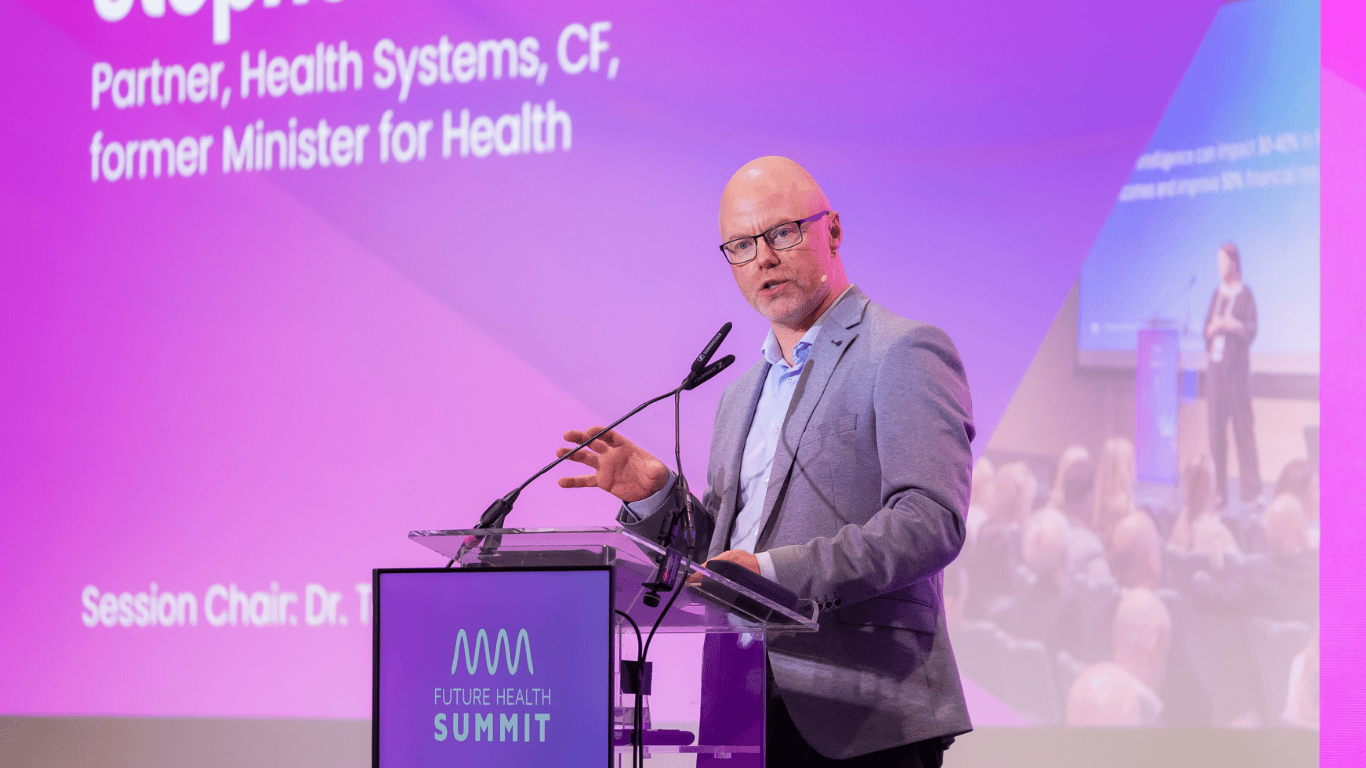
I was delighted to speak at the Future Health Summit this week about Ireland’s digital health journey. We’re five years into a ten-year transformation, and the HSE and our wider healthcare providers deserve a lot of credit for what they’ve achieved so far.
Here are some of the highlights from the Summit panel, both on the journey to date, alongside learnings from around the world on setting us up for success in the years ahead.
In understanding how much progress has been made by the HSE and the wider health community in recent years, it’s useful to go back a little. When I was appointed Minister for Health in 2020, there wasn’t much of a digital health ecosystem to speak of. There were pockets of success, NIMIS in radiology, the maternity EHR, but not many. Systems weren’t secure from attack. Covid teams were patching outdated platforms together. Many community and acute services were paper-based. There was no unique patient identifier and no patient-level population data. On almost every EU and OECD comparison of digital health, Ireland sat at or near the bottom.
What that looked like on the front line was deep levels of frustration from our clinicians. Many Non-Consultant Hospital Doctors, NCHDs, told me that the lack of digital health tools was their single biggest issue and one of the biggest opportunities we had to make things better. In one regional hospital, doctors told me they had to queue at one laptop to access part of a patient’s record, then queue at a second laptop to access the rest.
What changed
What’s happened since has been a generational shift. During Covid, our healthcare teams showed what they can do with a clear mission and the resources to act. The Covid tracker app, the national vaccine platform, EU Covid certificates, virtual outpatient services, remote home monitoring, eReferrals and electronic discharge summaries were all delivered at pace. Much of this was done while responding to and recovering from one of the most serious cyber-attacks ever inflicted on a European public service.
Post-Covid, we set about turning that emergency capability into a permanent platform, to bring in a new era of digital health in Ireland. We substantially increased the digital health budget, which had run at about one third of the EU average. We secured agreement on a unique patient identifier. We brought the Health Information Bill to the Oireachtas, where it now sits at Final Stage in the Seanad. And after wide consultation, we launched the National Digital Health Strategy in 2024.
The results are now visible. The HSE App is live and gaining functionality. The Shared Care Record is being rolled out. EHR procurement has started. Virtual wards are live. We’ll soon have our first fully digital hospital. Cyber security has been fundamentally rebuilt. None of this is finished, but for anyone who has watched this space for years, the change in pace is unmistakable. Many people deserve credit for this – Damien McCallion, Fran Thompson, Tom Laffan, Neal Mullen, Theresa Barry and many more, alongside Derek Tierney, Muiris O’Connor and their teams in the Department, and clinical leads including Dr Abdul-Karim, Dr Murphy and Loretto Grogan.
Four lessons from international experience
Last year I joined the healthcare consulting firm CF (Carnall Farrar) as Partner. Data and digital is one of CF’s specialty areas, and I drew on this to consider what can be learned from international experience to set Ireland up for continued success in digital health.
Lesson 1:
Ireland should use its last-mover advantage. Many countries rolled out digital health in waves over decades. They’re now spending serious money trying to make those systems talk to each other in a way that makes sense for the patient. Ireland has the rare luxury of rolling out the App, the Shared Care Record, the EHR platform and national data collection as part of the same digital transformation plan, including ensuring interoperability.
Lesson 2:
The technology is not the strategy. It enables the strategy. When Derek and I were putting the national framework together, we spoke to experts around the world. Many gave us the same advice – start with a clear picture of what you want to change for patients and staff, then implement technology that supports it. We heard examples of vast amounts of money being spent rolling out EHR platforms without a clear healthcare strategy or healthcare goals that the platform was to support. The result – things typically got worse, including lower productivity and frustrated clinicians.
Lesson 3:
Co-design with clinicians and patients. One thing I learned as Minister, and learned the hard way, is that lasting change requires clinical buy-in. It doesn’t matter how brilliant you think your idea is — if the clinicians don’t agree, it won’t happen, or not for very long anyway. In one North American example, an EHR platform was successfully delivered on technical terms — and then ignored, or worked around, by clinicians for years.
Lesson 4:
Successful digital transformation depends on what happens around the technology. Data quality, workflow redesign, leadership, trust, adoption, and a shared vision of better care. Digitising poor-quality data accelerates existing problems. Data transformation should run before or alongside digital transformation, not after. New models of care should be designed before the technology lands. Technology layered on unchanged workflows will not transform care.
The prize ahead
Looking to the future, the potential prize from digital health is enormous – Better population health, a new era in preventative and predictive care, transformed patient care, properly supported clinicians and researchers, greater productivity and cost effectiveness. Why? Because we are at the greatest nexus of healthcare innovation in history – AI and machine learning, genomics and precision medicine, cell and gene therapies, mRNA therapeutics, CRISPR and gene editing, wearables and biosensors, robotics and automation, advanced imaging — the list goes on. And central to most, if not all, of these innovations is high quality data.
Ireland is now well on its way to being able to benefit from, and contribute to, this extraordinary array of technological and scientific innovation. Five years ago the country was a digital health laggard. Five years from now it should be a leader.
Can this be done? Do the HSE and the wider healthcare ecosystem have what it takes to make this leap? The Irish Times recently reported that Ireland’s global healthcare ranking has moved from 80th in 2021 to 6th in 2025. That is what our healthcare workers are capable of when the HSE and the wider system pull together towards a shared vision. And that is what they can — and will — achieve in digital health too.
About CF
CF is a leading consultancy dedicated to making an enduring impact on health and healthcare. We work with leaders and frontline teams to improve health, transform healthcare, embed life science innovation and boost growth through investment. With unmatched access to UK healthcare data and award-winning data science expertise, our team are a driving force for delivering positive and meaningful change.
About the authors

Stephen Donnelly
Stephen Donnelly served as Ireland’s Minister for Health from 2020 to 2025, where he led comprehensive healthcare transformation including in women’s health services. He is now Partner at Carnall Farrar, advising health systems across the UK, Europe, and the Middle East on transformation, strategy, productivity, and integrated care delivery.